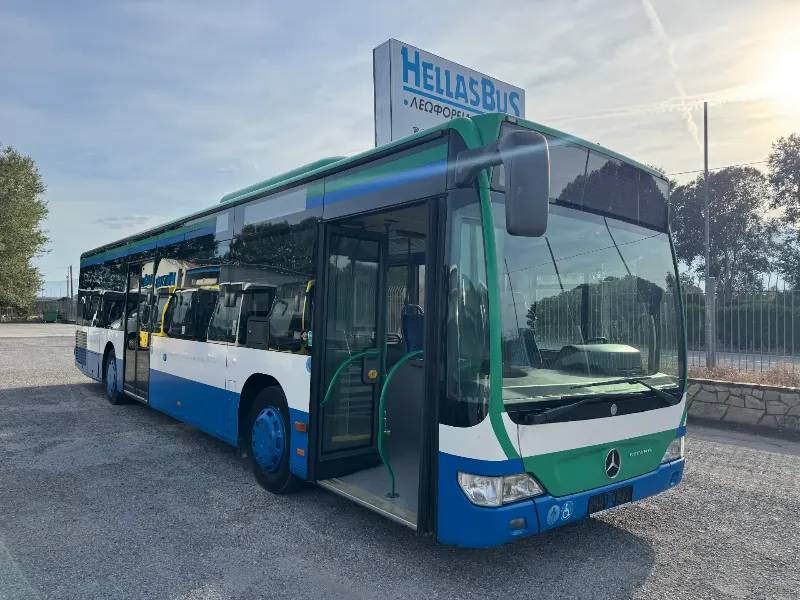
City bus
MERCEDES-BENZ CITARO
- Year of manufacture
- 2010
- Mileage
- 585,095 km
- Gearbox
- AUTOMATIC
- Emission class
- EURO 5
€16,900 + VAT
More...
The KTEL bus tenders in 11 Greek regions: Law 4974/2022, deadline extensions, contract values, award criteria and the fleet required (age, Euro class, access).
 The HellasBus team 14 min read

In 2026 the Greek Ministry of Infrastructure and Transport put regional intercity and urban bus services out to open tender for the first time. There are 11 tenders, one for every region except the North Aegean, plus one for intercity services in Attica. Together they are worth about €3.45 billion. Each winner gets an exclusive right to the routes of its region for 10 years, with a possible 5-year extension. By mid-October 2026 the bid deadlines had been extended several times and no contract had been awarded.
The KTEL are the regional bus companies that run Greece’s intercity buses, and many of them are our customers. They will bid in these tenders, alone or in consortia. Below is a summary of the current rules, the new law, where each tender stands and what the tender notice asks of the winner, especially for buses.
The KTEL currently operate under Law 2963/2001 (Government Gazette A’ 268). Each KTEL runs the scheduled intercity routes of its prefecture, and in many towns the urban routes too, with an exclusive right and no tender. The law turned most KTEL into public limited companies (KTEL S.A.), whose shareholders are the local bus owners. A few did not convert and operate in the form set out in article 5 of the same law.
The KTEL were set up by Law 2119/1952, one for each prefecture and island. In 1968 they were merged into 8 regional bodies, but in 1973 Decree 102/1973 brought back the organisation by prefecture. Some smaller prefectures are served by a neighbouring KTEL. The full story is in our article on the history of the KTEL.
There is no general operating subsidy. The state reimburses the KTEL for revenue lost on reduced and free fares, under article 86 of Law 4530/2018. For 2026 the decision of 6 October provides €11.77 million for fares for people with disabilities and large families, across urban and intercity KTEL and the municipal bus services of Kos and Rhodes. Fares are set by the ministry. In March 2026 Ministerial Decision 37279/2026 (Gazette B’ 1258) raised them by 5% to 10%. The same month, Law 5290/2026 amended several articles of Law 2963/2001, including the funding for replacing KTEL buses.
Costs also rose in 2026. By March, diesel was about 40% more expensive than at the start of the year, up from €1.520 to €2.118 per litre. The government subsidised diesel by 16 cents per litre at the distribution level, and the federation of intercity KTEL (POAYS) asked for €15 million in emergency support for all KTEL.
The tenders are required by EU Regulation (EC) 1370/2007, which says public passenger transport with exclusive rights must be awarded through an open tender. Direct awards are allowed only as exceptions, such as small networks. For road transport, the regulation’s transition period ended on 3 December 2019.
Greece was late. In 2013 Law 4199/2013 set up a Passenger Transport Regulatory Authority (RAEM) to run the tenders, but none were held. In 2022 Law 4974/2022 abolished RAEM and gave the job to the ministry. Launching all the tenders by 30 April 2026 was a milestone for Recovery Fund financing. In January 2026 Deputy Minister Konstantinos Kyranakis said direct awards “conflict with EU law” and cannot continue.
Law 4974/2022 (Government Gazette A’ 185, 29.9.2022) is the new framework for intercity and urban road passenger transport. Its main points:
The law does not cover urban transport run by OASA in Attica, OSETh in Thessaloniki, or the municipal companies of Rhodes and Kos.
There is one tender per region, except the North Aegean, and one more for intercity services in Attica. Most have two lots: one for intercity routes and one for urban routes in the larger towns. The Central Greece (Sterea Ellada) notice came first, on 12 March 2026, and became the template for the rest.
| Region | Scope | Estimated 10-year value (excl. VAT) | Bid deadline |
|---|---|---|---|
| Crete | Intercity, urban Heraklion and Chania | €490.5m | 19 October |
| Western Greece | Intercity Achaia, Ilia, Aitoloakarnania, urban Patras | €435m | 21 October |
| Peloponnese | Intercity in 5 regional units | €325m | 21 October |
| Ionian Islands | Intercity, urban Corfu | about €220m | 22 October |
| West Macedonia | Intercity (Kozani, Kastoria and others) | €118.5m | 22 October |
| East Macedonia and Thrace | Intercity, urban Kavala | €383.5m | 23 October |
| Attica | Intercity | No published figure found | 26 October |
| Central Macedonia | Intercity in 7 regional units, urban Katerini | €413m | 30 October |
| Epirus | Intercity, urban Ioannina | €260m | 30 October |
| South Aegean | Intercity (Rhodes, Mykonos) | €81.5m | 2 November |
| Thessaly | Intercity, urban Larissa and Volos | €449m | 9 November |
| Central Greece | Intercity, urban Lamia and Chalkida | €277.5m | 11 November |
The values come from the tender notices as compiled by The Opinion and Oikonomikos Tachydromos, and exclude the optional 5 years. With the option, Crete reaches €735.75m and Central Greece €416.25m. The deadlines come from the extension decisions signed by Alternate Minister Giorgos Kotsiras on Diavgeia (September and October 2026), and close at 12:00 local time. They change often, so check the current deadline on the Greek e-procurement system ESIDIS (promitheus.gov.gr).
Some small urban networks, such as Serres, Drama, Veria, Naousa and Kozani, are left out of the tenders. According to press reports, they will continue under the article 25 rule for small services.
North Aegean: no tender has been launched here. On Chios intercity bus services stopped in summer 2025, and in June 2026 the region revoked the operator’s licence. On 15 September 2026 the ministry approved emergency services by a private company: they run for 10 weeks at first, can be extended for up to 2 years, and end as soon as a contractor under Law 4974/2022 takes over.
The deadlines moved many times, mainly because the ministry amended the tender documents after questions and requests for clarification from interested parties. In Crete the first deadline was 11 May 2026. It then moved to 12 June and 18 September, and it is now 19 October. Central Greece, the first tender, has been extended at least five times and its deadline is now 11 November.
Meanwhile the KTEL keep running as before. Law 4974/2022 allowed two years to complete the awards, but that period is extended while administrative or court proceedings are pending. POAYS says the KTEL are ready and is asking for quick decisions, because the repeated extensions keep the sector in uncertainty. Sources quoted by The Opinion say the nationwide transition could take 5 to 6 years.
The details below come from the codified Central Greece tender notice of 28 May 2026. The other tenders follow the same template, with different figures per region.
Who can bid
How bids are scored
| Criterion | Weight | What it measures |
|---|---|---|
| Price (B) | 31% | Discount on maximum fares (20%), discount on passes and return tickets (6%), extra kilometres up to +10% (5%) |
| Station and fleet readiness (E) | 29.5% | Being ready sooner than 6 months for the fleet and 1 year for stations earns more points |
| Drivers (O) | 29.5% | Average experience, minimum 5 years, with extra points up to 10 |
| Bus age (L) | 10% | 25 years scores 100 points and each year younger adds 2, up to 150 |
The winner gets no operating subsidy. It keeps the fares, which the notice calls “the only compensation”, plus reimbursement for reduced fares and advertising income. Demand risk is the winner’s. The one exception in Central Greece is urban Lamia and Chalkida, where the state may provide electric buses. The benefit from them must reach passengers as lower fares.
Guarantees, penalties and other terms
Within 6 months of signing, the winner must have a minimum number of buses on the road, plus a 10% reserve. Every bus needs telematics and electronic ticketing. New and used buses are allowed, up to 25 years old, diesel Euro III or newer, or zero-emission.
| Region | Minimum fleet (excluding the 10% reserve) |
|---|---|
| Central Greece | 305 intercity (Evia 125, Fthiotida 83, Thebes 40, Fokida 37, Livadia 20) and 56 urban (Lamia 28, Chalkida 28) |
| Western Greece | 368 intercity (Aitoloakarnania 141, Achaia 132, Ilia 95) and 78 urban in Patras |
| Ionian Islands | 161 intercity (Corfu 63, Kefalonia-Ithaca 37, Lefkada 33, Zakynthos 28) and 32 urban in Corfu |
| Thessaly | 416 buses in total |
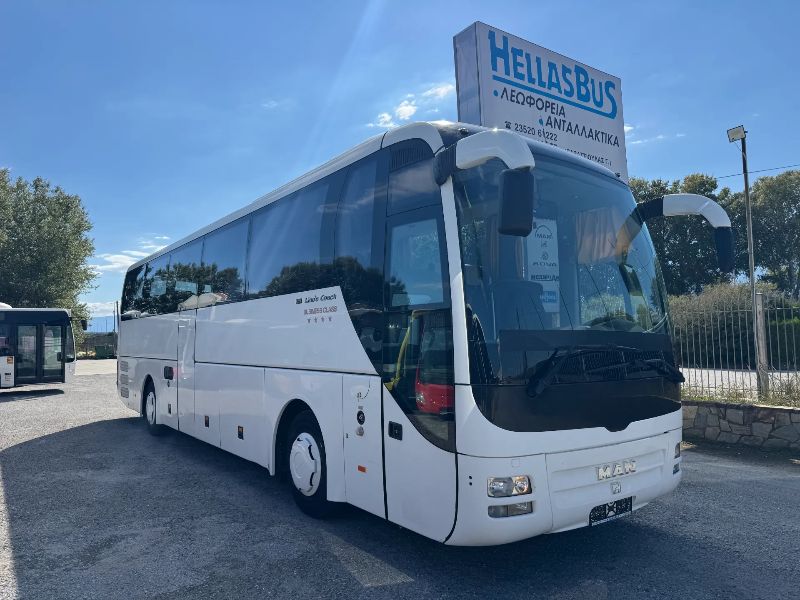
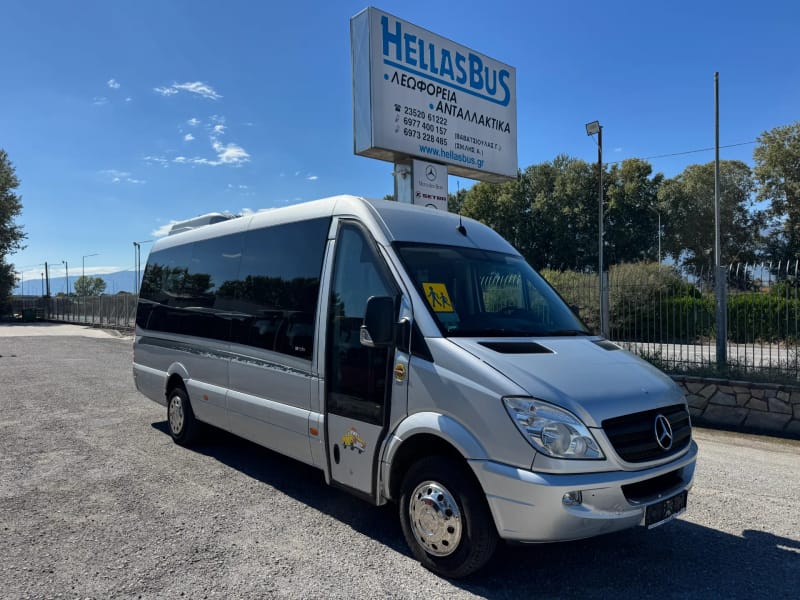
Buses we own, parked at our premises in Litochoro, Pieria, ready to be inspected.
City bus
€16,900 + VAT
More...Intercity / tourist coach
€51,900 + VAT
More...Intercity / tourist coach
€29,900 + VAT
More...The main bus requirements in the Central Greece notice:
Until the new contracts start, the limits of Law 2963/2001 apply, and for buses entering service for the first time they are stricter than the tender’s 25 years. Age is counted from the chassis build year, without counting that year itself.
| Case | Limit | Law |
|---|---|---|
| Intercity or suburban bus entering service in Greece for the first time, new or imported used | Up to 15 years | Article 11, Law 2963/2001 |
| City bus entering service for the first time | Up to 18 years | Article 35, Law 4530/2018 |
| Mandatory withdrawal | At 27 years | Article 11, Law 2963/2001 |
| Replacing a bus withdrawn for age | Within 4 months | Article 31, Law 2963/2001 |
In practice, a used intercity bus that a KTEL brings in from Europe today must be no older than 15 years. Such a bus also meets the tender’s 18-year limit for buses added during the contract. For more detail, with examples of how age is counted, see our article on bus age limits. Before buying, confirm the limit with your KTEL’s management.
The KTEL are forming joint bids to meet the financial criteria, because a single KTEL usually does not reach 70% of the turnover of a whole region. In Western Greece, for example, the criterion for all intercity routes is average annual turnover of about €24.7 million. In several regions the KTEL have announced that they will bid together, as a single group for the whole region.
Foreign groups have also shown interest, and the press reports exploratory contacts between foreign investors and KTEL in Western Greece. Who wins where will only be known when the bids are opened.
KTEL shareholders ask whether the terms ensure the winner is financially sound or simply shut out smaller groups, and why smaller lots cannot be bid for separately.
Urban transport in Athens (OASA) and Thessaloniki (OSETh) is outside Law 4974/2022 and has its own framework.
For a KTEL bidding in a tender, the fleet is scored, as well as being an entry requirement. Bus age counts for 10%, and how fast the fleet can be on the road counts within the 29.5% for readiness. In practice:
In the HellasBus catalogue you will find intercity buses and coaches and low-floor city buses, with year, emission class and equipment in every listing. If you are preparing a tender bid and need a set number of buses, a maximum age or a wheelchair lift, tell us what the notice requires. We will tell you what we have or what we can find. To check each vehicle, see the pre-purchase checklist. Call +30 23520 61222 or send us a WhatsApp message.
The KTEL operate under Greek Law 2963/2001, which gives each one an exclusive right in its prefecture without a tender. Law 4974/2022 says they keep running the services until the tender winners take over. Once the new contracts start, articles 1 to 32 of Law 2963/2001 are repealed.
Ten years, with a possible extension of up to five more, under article 20 of Law 4974/2022 and article 4 of Regulation (EC) 1370/2007. The winner gets an exclusive right to the routes of the region.
Yes. Any road passenger transport operator licensed under Regulation (EC) 1071/2009 can bid, alone or in a consortium, if it meets the financial and technical criteria of the tender.
Until the new contracts start, Law 2963/2001 applies. An intercity bus entering service in Greece for the first time, new or used, must be no older than 15 years, and a city bus no older than 18, counted from the chassis build year without counting that year itself. Buses must be withdrawn at 27 years.
Yes. The Central Greece tender notice, which is the template for the others, explicitly accepts new or used buses up to 25 years old, diesel Euro III or newer or zero-emission. Buses added or replaced during the contract must be no older than 18 years.
Not right away. In October 2026 bid deadlines were still open. After award and signature, the winner has up to six months for the fleet and up to one year for the stations. Until then the current KTEL run the services.
 Buying a bus
 13 min read
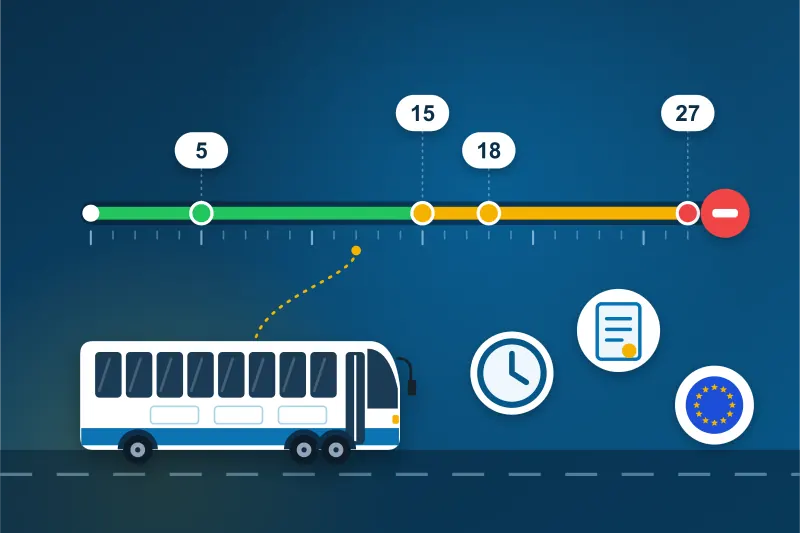
The maximum age at which a KTEL or tourist bus can enter service in Greece, when it must retire, how age is counted and what applies to imports, with the laws.
Read the article History
 7 min read
Explore the history of Greece's KTEL buses, from independent operators to regional networks, and their role in connecting villages, families and communities.
Read the article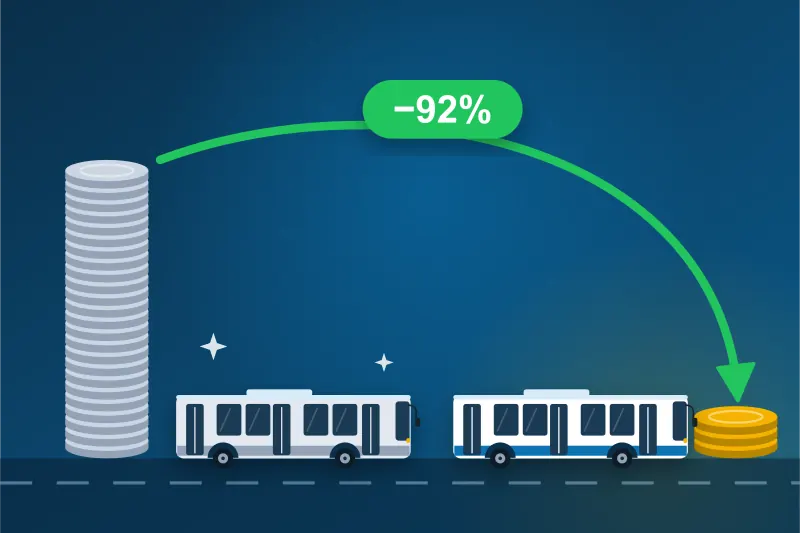 Buying a bus
 8 min read
A new Citaro costs €296,000 or more excl. VAT. A used Citaro city bus costs about €25,000. Tender prices, listings, interest, depreciation and payback compared.
Read the articleCall or message us: we tell you what we have in stock and search for what we do not.