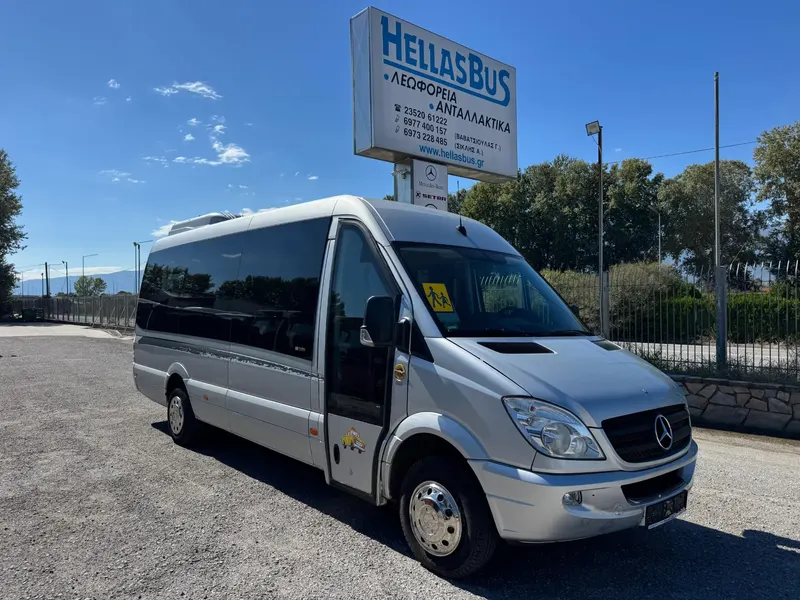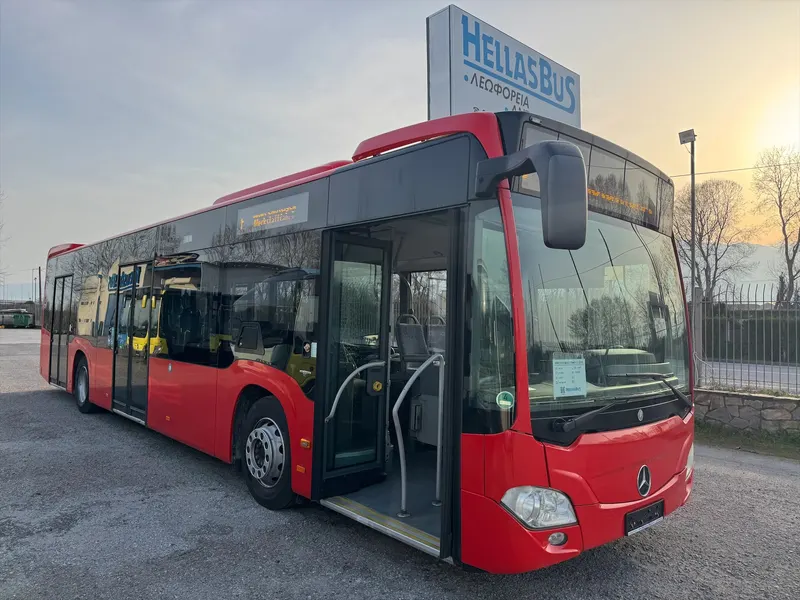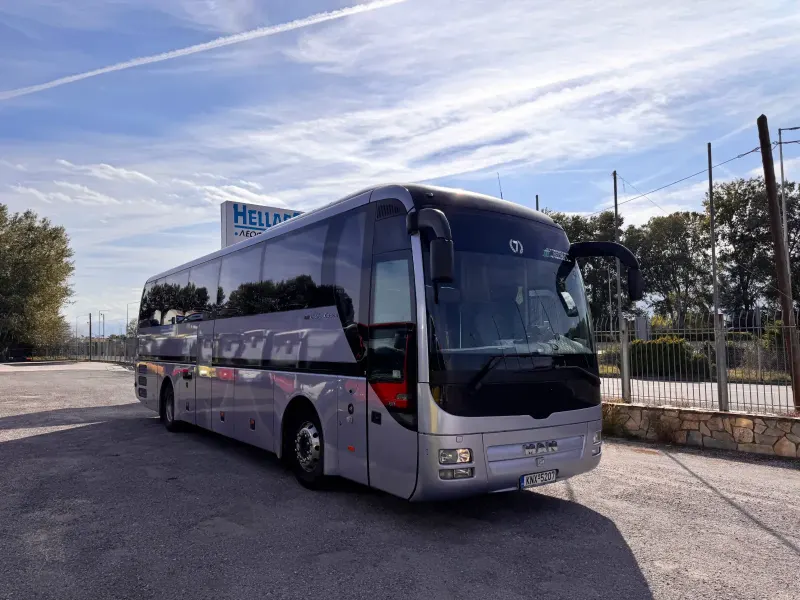
Intercity / tourist coach
MAN LION'S COACH R07
- Year of manufacture
- 2011
- Mileage
- 990,000 km
- Gearbox
- Manual
- Emission class
- EURO 5
€71,900 + VAT
More...
Euro 7 for buses and coaches: when it applies (2028 and 2029), new NOx and particle limits, on-board monitoring, lifetime rules and what it means for Euro 6 buses.
 HellasBus Team 6 min read
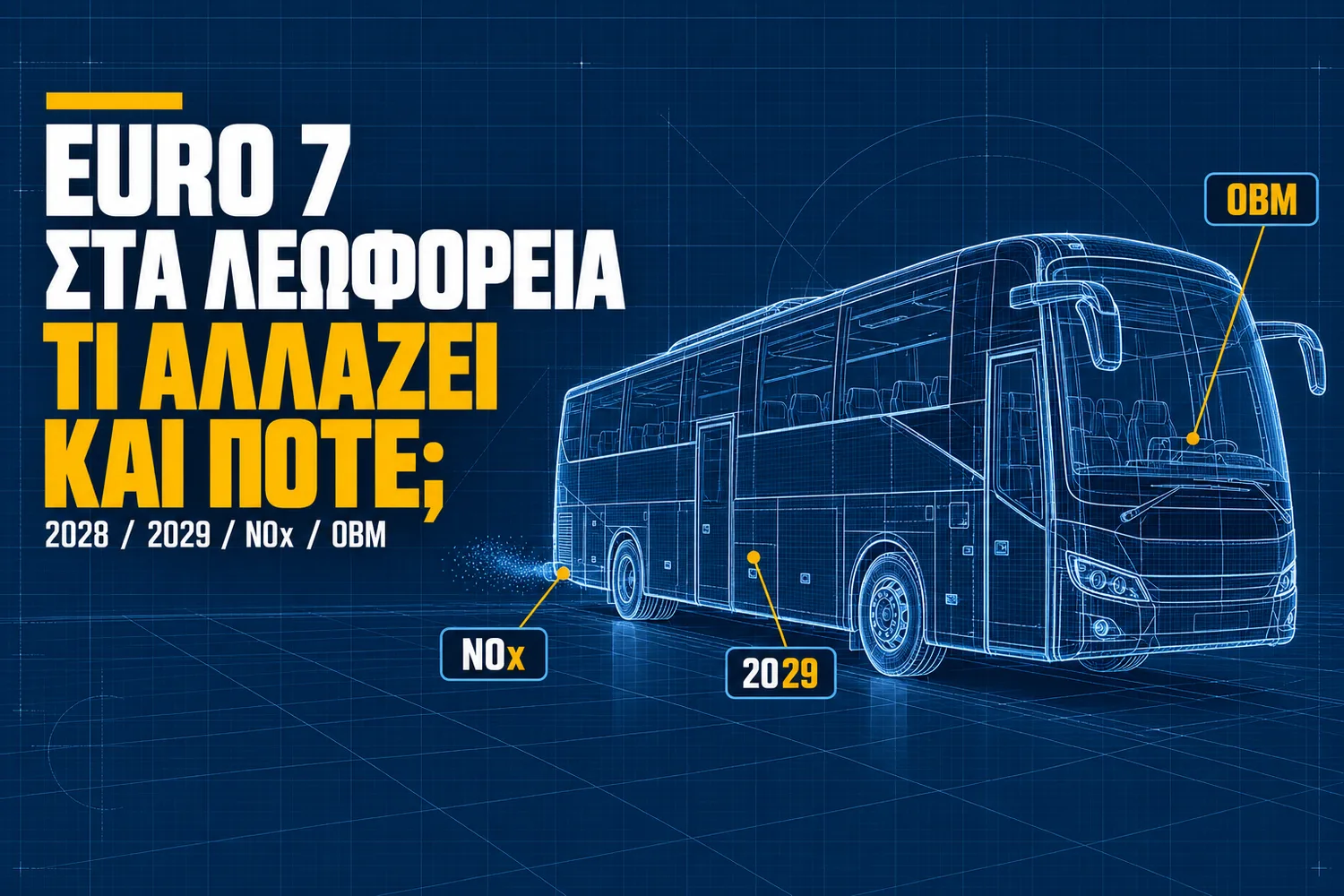
Euro 7 is the new EU emissions regulation for vehicles, Regulation (EU) 2024/1257. For buses and coaches it starts on 29 May 2028 for new types and on 29 May 2029 for every new vehicle registered. Buses already on the road are not affected.
Below you will find the dates, the new limits compared with Euro VI, what changes in the vehicle’s equipment, and what it all means if you buy or run Euro 6 buses. Every figure comes from the official EU texts on EUR-Lex.
It is a single regulation for cars, trucks and buses that replaces the two old ones: 715/2007 (Euro 5 and 6 for light vehicles) and 595/2009 (Euro VI for heavy vehicles). It was signed on 24 April 2024, published in the Official Journal on 8 May 2024 and entered into force on 28 May 2024.
Entry into force does not mean the new limits already apply. The regulation gives manufacturers time, with different dates for each vehicle category. Beyond exhaust gases, it is also the first to cover particles from brakes and tyres and the durability of batteries.
Buses belong to categories M2 (up to 5 tonnes, for example minibuses) and M3 (over 5 tonnes). The same dates apply to them as to trucks.
| Date | What applies from then |
|---|---|
| 28 May 2024 | The regulation enters into force |
| 29 November 2026 | New types of cars and vans (for comparison) |
| 29 May 2028 | New bus, coach and truck types are approved only as Euro 7 |
| 29 May 2029 | Every new bus registered, sold or put into service must be Euro 7 |
| 31 December 2029 | End of the exemption for certain new city buses with Euro VI approval |
| 1 July 2031 | Deadline for small bus manufacturers |
The 2029 exemption covers new buses in categories with a zero-emission target under the CO2 Regulation (EU) 2019/1242: they may be registered with Euro VI approval until the end of 2029. A small manufacturer is one that registers fewer than 450 M2 and M3 buses a year in the EU, which mainly concerns small bodybuilders.
Limits are measured per kilowatt-hour of engine work (mg/kWh), as in Euro VI. The big change is in nitrogen oxides (NOx): the European Commission announced that for trucks and buses the limit is “halved, from 400 to 200 mg per kWh”. Limits are also added for pollutants that were not measured on every engine before.
| Pollutant | Euro VI (WHTC, diesel) | Euro 7 (laboratory) | Euro 7 (on the road) |
|---|---|---|---|
| NOx | 460 mg/kWh | 200 mg/kWh | 260 mg/kWh |
| Particles (mass) | 10 mg/kWh | 8 mg/kWh | - |
| Particles (number) | 6×10¹¹ /kWh | 6×10¹¹ /kWh, from 10 nm | 9×10¹¹ /kWh |
| CO | 4,000 mg/kWh | 1,500 mg/kWh | 1,950 mg/kWh |
| NH3 (ammonia) | 10 ppm | 60 mg/kWh | 85 mg/kWh |
| N2O (nitrous oxide) | no limit | 200 mg/kWh | 260 mg/kWh |
| CH4 (methane) | gas engines only | 500 mg/kWh | 650 mg/kWh |
The tests stay the same as in Euro VI: WHSC and WHTC cycles in the laboratory, and on-road measurement with portable equipment. In Euro 7, however, the on-road limits are written as separate values with no extra tolerance. Particles are now counted from 10 nanometres, so smaller ones count than before. There is no formaldehyde limit yet: the Commission will review it by the end of 2027.
What the earlier classes meant is explained in Euro 5, EEV or Euro 6.
A Euro 7 bus must stay within the limits for many more years than a Euro VI bus. For large buses and coaches, the main lifetime goes from 7 to 12 years, with the same 700,000 kilometres.
| Category | Euro VI | Euro 7, main lifetime | Euro 7, additional lifetime |
|---|---|---|---|
| M3 over 7.5 t (most city buses and coaches) | 700,000 km or 7 years | 700,000 km or 12 years | up to 875,000 km or 15 years |
| M3 up to 7.5 t | 300,000 km or 6 years | 300,000 km or 8 years | up to 375,000 km or 10 years |
| M2 (minibuses) | 160,000 km or 5 years | 160,000 km or 8 years | up to 200,000 km or 10 years |
Whichever comes first applies, kilometres or years. During the additional lifetime the limits for gases are relaxed by a factor of 1.2, which for heavy vehicles was set by Delegated Regulation (EU) 2026/1216.
The most important new system is OBM (On-Board Monitoring). A Euro 7 bus continuously monitors its own NOx, ammonia and particles and detects when it exceeds the limit by at least 2.5 times. It then warns the driver, without stopping the trip in progress.
For the AdBlue and particle filter systems that Euro 6 buses already have, proper care is described in our bus maintenance tips.
Not yet. The regulation provides for limits on particles from brakes and tyre wear, but the values for buses and trucks have not been set. The Commission will present a study on brakes by the end of 2027 and will then set limits by a further act.
For bus tyres (class C3), the dates are 1 April 2032 for new types and 1 April 2034 for all new tyres, with limits still to be set. Numerical battery durability limits currently exist only for cars and vans, not for electric buses.
Nothing changes for them. The regulation covers approval of new types and first registration of new vehicles. It contains no retrofit obligation, no ban on use and no other provision for buses that are already registered.
Euro 7 also contains no provisions on low-emission zones in cities. Those are set by national governments and municipalities. We have collected the age limits for regional lines, tourist coaches and imports in our article on bus age limits.
In practice, Euro 6 buses will remain the newest diesel option on the used market for several years. New Euro 7 buses will cost more. When it proposed the regulation in 2022, the Commission estimated an extra cost of about €2,600 to €2,700 per truck or bus. That estimate referred to the original proposal, which had stricter limits than the final regulation.
If you are considering a new bus delivered after May 2029, it will be Euro 7. If you order earlier, ask the manufacturer which approval it will be registered under and when. For a cost comparison between new and used, see used or new bus.
If you are looking for a used bus, a Euro 6 bus remains a fully legal and practical choice for many years. The available HellasBus buses show their emission class in each listing. For any question, call +30 23520 61222 or send a WhatsApp message to +30 6977 400157.
Buses we own, parked at our premises in Litochoro, Pieria, ready to be inspected.
Intercity / tourist coach
€71,900 + VAT
More...Intercity / tourist coach
€29,900 + VAT
More...City bus
Call for price
More...For new bus and coach types from 29 May 2028, and for every new bus registered from 29 May 2029. Small manufacturers, with fewer than 450 buses a year in the EU, have until 1 July 2031.
No. Regulation (EU) 2024/1257 covers type approval and first registration of new vehicles. It contains no retrofit obligation and no ban on buses that are already registered.
The NOx limit on the steady-state test (WHSC) falls from 400 to 200 mg/kWh, half the previous value, as the European Commission put it. On the transient test (WHTC) it falls from 460 to 200 mg/kWh, and the on-road limit is 260 mg/kWh.
Partly. Every new bus, electric ones included, will have a digital Environmental Vehicle Passport and battery health monitoring. Numerical battery durability limits have so far been set only for cars and vans.

News / Updates 14 min read
The KTEL bus tenders in 11 Greek regions: Law 4974/2022, deadline extensions, contract values, award criteria and the fleet required (age, Euro class, access).
Read the article
Buying a bus 6 min read
Euro 5, EEV and Euro 6 buses compared: NOx and particulate limits, key dates, AdBlue, particulate filters and what each class means when you buy a used bus.
Read the article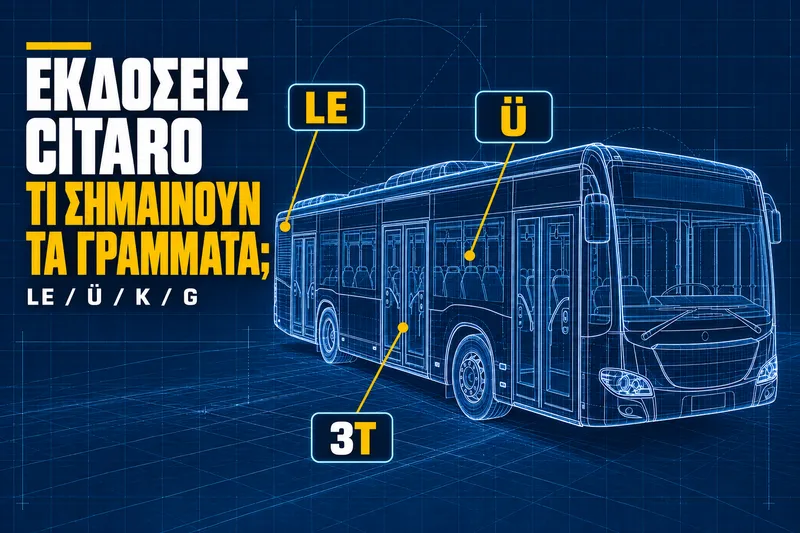
Models 5 min read
What LE, Ü, MÜ, K, L, G and 3T mean on a Mercedes-Benz Citaro: low floor or low entry, city or intercity, lengths, doors and fuel types at a glance.
Read the articleCall or message us: we tell you what we have in stock and search for what we do not.