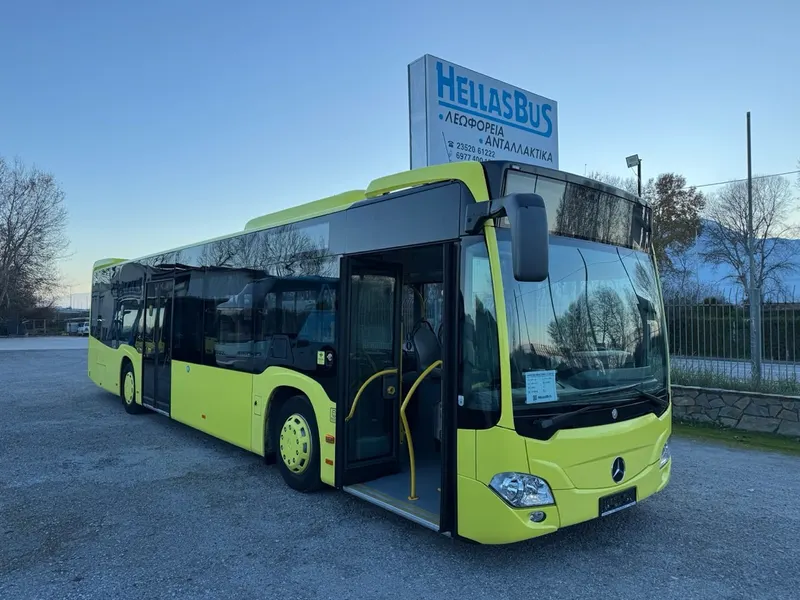
City bus
MERCEDES-BENZ CITARO C2
- Year of manufacture
- 2014
- Mileage
- 646,566 km
- Gearbox
- Automatic
- Emission class
- EURO 6
Call for price
More...
What LE, Ü, MÜ, K, L, G and 3T mean on a Mercedes-Benz Citaro: low floor or low entry, city or intercity, lengths, doors and fuel types at a glance.
 HellasBus Team 5 min read
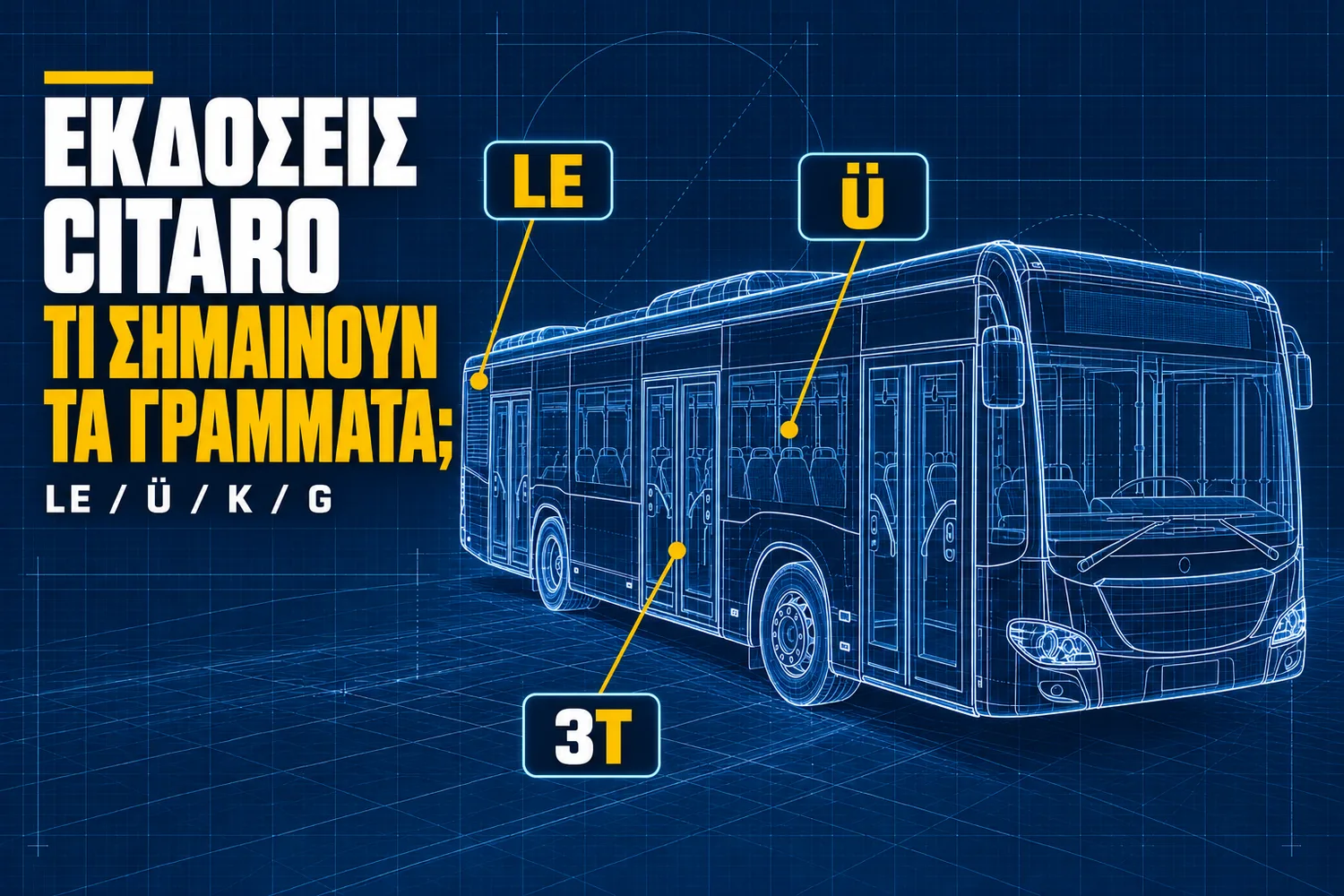
The letters after the Citaro name tell you three things: how long the bus is, how low its floor is and what kind of work it was built for. LE means low entry, Ü intercity, K short, G articulated, and 3T in a listing usually means 3 doors.
For the history, generations and engines, see our article on the history of the Mercedes-Benz Citaro. Here we stick to the differences between versions, so you know what you are reading in a listing.
Most of the letters are initials of German words, because the Citaro was designed in Germany. The factory code is O 530, so you will also see names such as O 530 G or O 530 LE.
| Letter | Comes from | Meaning |
|---|---|---|
| (none) or NF | Niederflur | City bus, low floor along the whole length, 12 m |
| LE | Low Entry | Low at the front, higher at the rear |
| Ü | Überland | Intercity version, for suburban and intercity routes |
| M (in MÜ, LE MÜ) | medium length | 13 m instead of 12 m |
| K | Kurz | Short, about 10.5 m |
| L | Lang | Long, 15 m with 3 axles (first generation only) |
| G | Gelenk | Articulated (“bendy bus”), about 18 m |
| GL / CapaCity | Gelenk lang | Long articulated with 4 axles, 19.5 m or 21 m |
| 2T / 3T | Türen | Number of passenger doors (listing shorthand) |
| C2 | - | Second generation, from 2011 |
| NGT / CNG | - | Natural gas engine |
| e (eCitaro) | - | Battery electric, from 2018 |
The letters combine. A Citaro LE Ü is a low-entry intercity bus, a Citaro GÜ an articulated intercity bus, and a “Citaro C2 G 4T” a second-generation articulated bus with 4 doors.
The big difference is the floor. The standard Citaro has a low floor from the first door to the last. The Citaro LE is low only up to just behind the middle door; from there back, the floor rises with steps.
| Citaro (low floor) | Citaro LE (low entry) | |
|---|---|---|
| Floor | Low along the whole length | Low at the front and middle, higher at the rear |
| Rear seats | On raised platforms, with a small step | On a higher floor, behind steps |
| Engine | Rear left, horizontal or upright (“tower”) | Rear centre, under the floor |
| Axle / gearbox | More complex layout to keep the floor low | Taken from the intercity and coach range |
| Rear door | Yes, on 3-door versions | If fitted, single-width |
| Best for | City, many stops, standing passengers, wheelchairs | City and suburbs, more seated passengers |
On a low-floor bus, passengers, buggies and wheelchairs board without a step at any door. On the LE the rear half feels more like an intercity bus, and the mechanical parts are simpler to service.
The Citaro Ü is the 12-metre intercity version. It usually has 2 doors instead of 3 and more seats, all on raised platforms, so that most passengers sit on routes outside the city. The Mercedes-Benz 2019 technical sheet gives the 2-door Citaro Ü 43 seats and 39 standing places.
The Ü keeps the low entry and the folding ramp, so it suits regional routes with many village stops. For long distances with luggage in the hold you need a high-floor intercity bus, such as the Integro and Intouro.
The Citaro came in lengths from 10.5 to 21 metres. The longer the bus, the more passengers it carries, and the harder it is on narrow streets and tight corners.
| Version | Length | Axles | Doors |
|---|---|---|---|
| Citaro K | 10.5 m | 2 | 2 or 3 |
| Citaro, LE, Ü, LE Ü | 12 m | 2 | 2 or 3 |
| Citaro MÜ, LE MÜ | 13 m | 2 | 2 or 3 |
| Citaro L, LÜ | 15 m | 3 | 2 or 3 |
| Citaro G, GÜ | 18 m | 3 | 3 or 4 |
| CapaCity | 19.5 m | 4 | 3 or 4 |
| CapaCity L | 21 m | 4 | 4 or 5 |
The L existed only in the first generation, while the CapaCity L arrived with the second (C2). The 12-metre bus is by far the most common on the used market.
With 3 doors, passengers get on and off faster, which matters on a city route with a stop every few hundred metres. With 2 doors you gain seats at the rear, which matters on a suburban or intercity route.
That is why city Citaros are usually 3T, Ü versions 2T, and articulated G buses 3T or 4T. If you need the bus for school runs or staff transport, a 2T with more seats is usually the more practical choice.
Most used Citaros are diesel. The NGT (formerly CNG) runs on natural gas and carries its tanks on the roof, so it needs a CNG station near the depot. Since 2017-2018 there has also been the Citaro hybrid, a mild hybrid with a small 14 kW electric motor that assists the engine when pulling away.
The eCitaro is fully electric, from 2018. For the emission class of each diesel (Euro 5, EEV or Euro 6), see Euro 5, EEV or Euro 6.
| Work | Version that fits |
|---|---|
| Municipal transport, many stops | Citaro 12 m, 3 doors |
| Narrow streets, islands, historic centres | Citaro K |
| Very busy routes | Citaro G or CapaCity |
| Suburban and regional routes | Citaro Ü or LE Ü, 2 doors |
| More seats on a longer route | Citaro MÜ or LE MÜ (13 m) |
| Staff transport, school runs | Citaro LE or Ü, 2 doors |
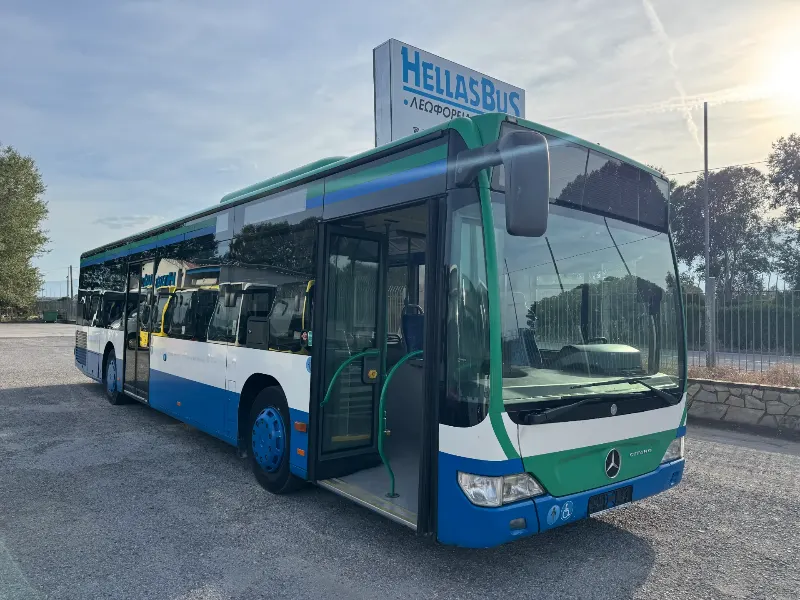
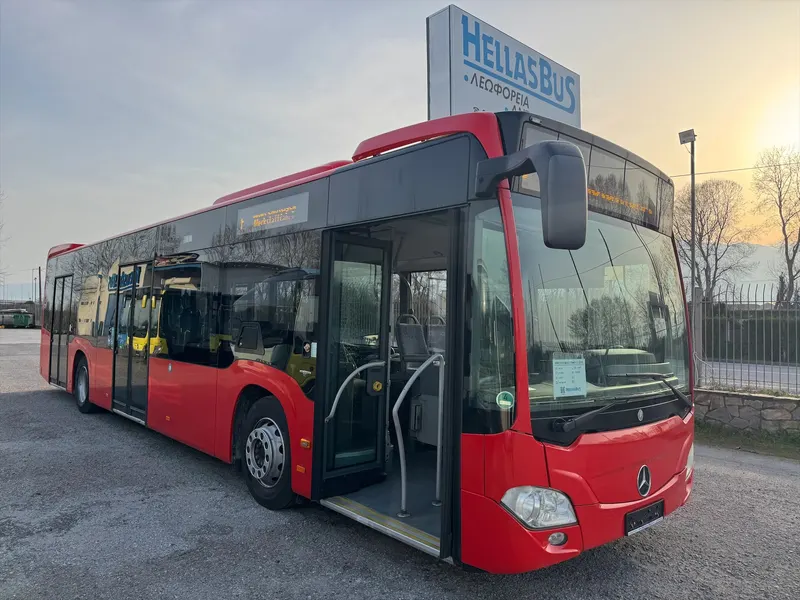
Buses we own, parked at our premises in Litochoro, Pieria, ready to be inspected.
City bus
Call for price
More...City bus
Call for price
More...City bus
€16,900 + VAT
More...All the Citaro buses we have available are on the used Mercedes-Benz Citaro page. Each listing shows year, mileage, gearbox, emission class and price. We own every vehicle, and they are at our yard in Litochoro, Pieria, where you can see them up close.
If you are not sure which version you need, tell us the route and how many passengers you carry, and HellasBus will suggest one. Call +30 23520 61222 or send a WhatsApp message to +30 6977 400157.
The standard Citaro has a low floor along its whole length, with the rear seats on raised platforms. The Citaro LE (Low Entry) is low only up to just behind the middle door. Behind that the floor rises with steps, and the engine sits underneath, paired with an axle and gearbox from the intercity range.
Ü comes from the German word Überland and marks the intercity version. It is a 12-metre bus, usually with 2 doors and more seats than the city bus, built for suburban and intercity routes.
In listings, 2T and 3T usually give the number of passenger doors (from the German Türen). City Citaros normally have 3 doors, intercity versions 2, and articulated buses 3 or 4.
The Citaro MÜ and Citaro LE MÜ are the medium-length versions, about 13 metres long with 2 axles. They are one metre longer than the standard Citaro and fit an extra row of seats.
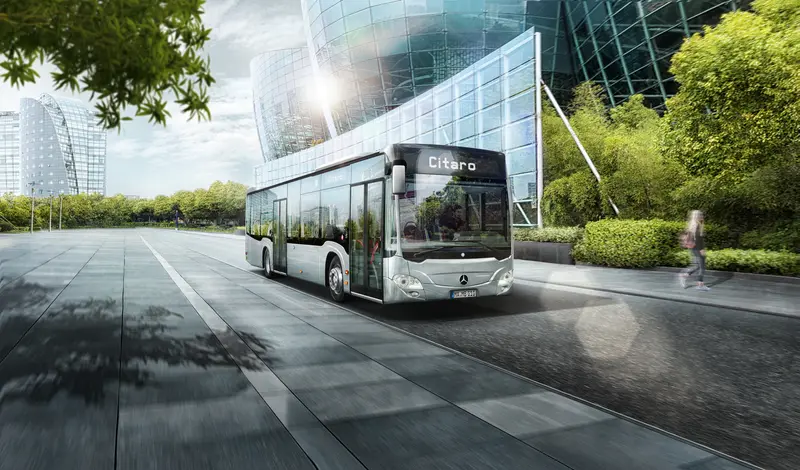
Models 5 min read
Mercedes-Benz Citaro since 1997: O530 and C2 generations, K, G, LE and Ü versions, OM 906, OM 457, OM 936 and OM 470 engines, and where to find a used one.
Read the article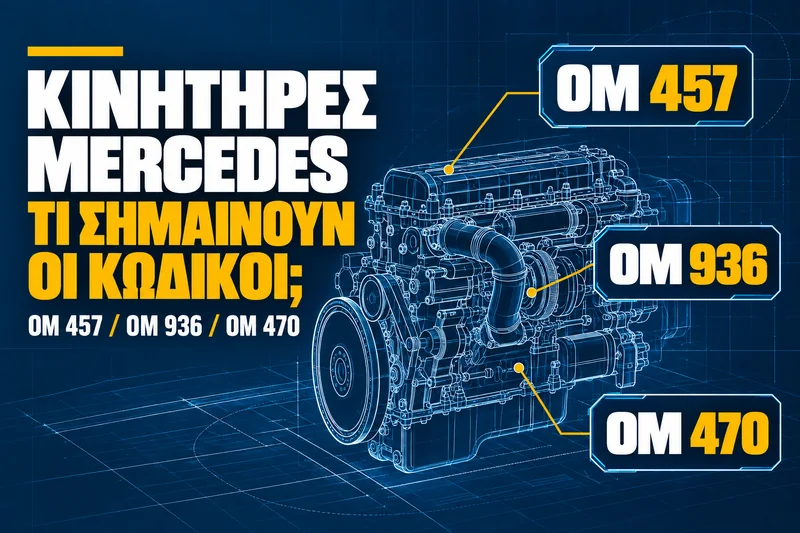
Models 13 min read
Mercedes-Benz bus engines from 1954 to today: what OM 457 hLA, OM 906, OM 936 and OM 470 mean, displacement, power and which Citaro, Tourismo or Integro has which.
Read the article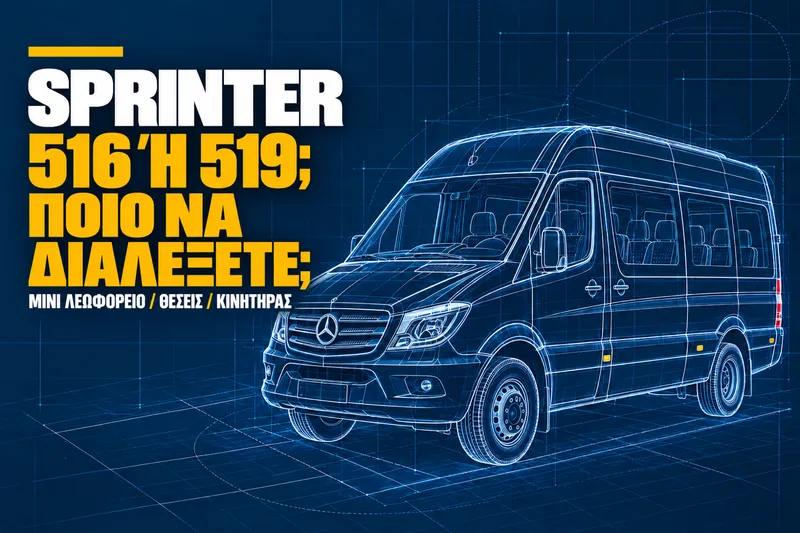
Models 6 min read
Mercedes-Benz Sprinter as a minibus: generations since 1995, what 516 and 519 mean, engines, seats, D1 or D licence and which version suits your business.
Read the articleCall or message us: we tell you what we have in stock and search for what we do not.