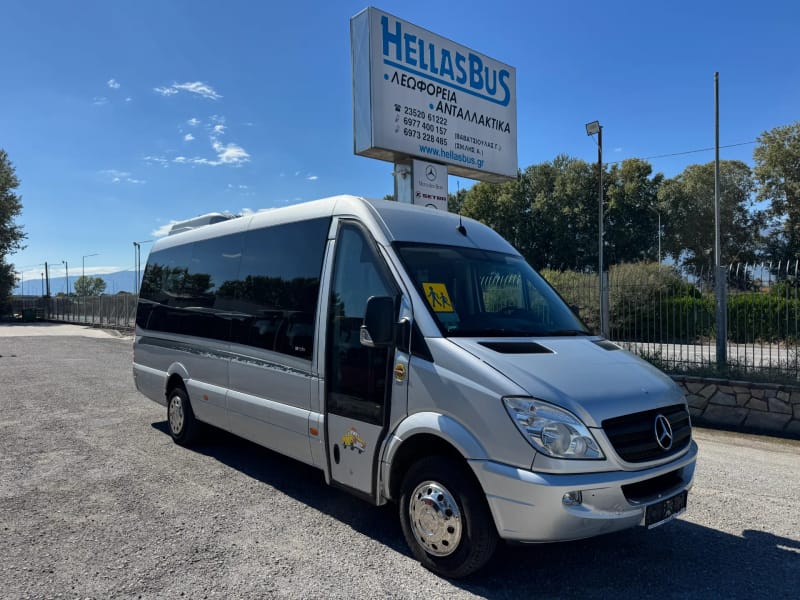
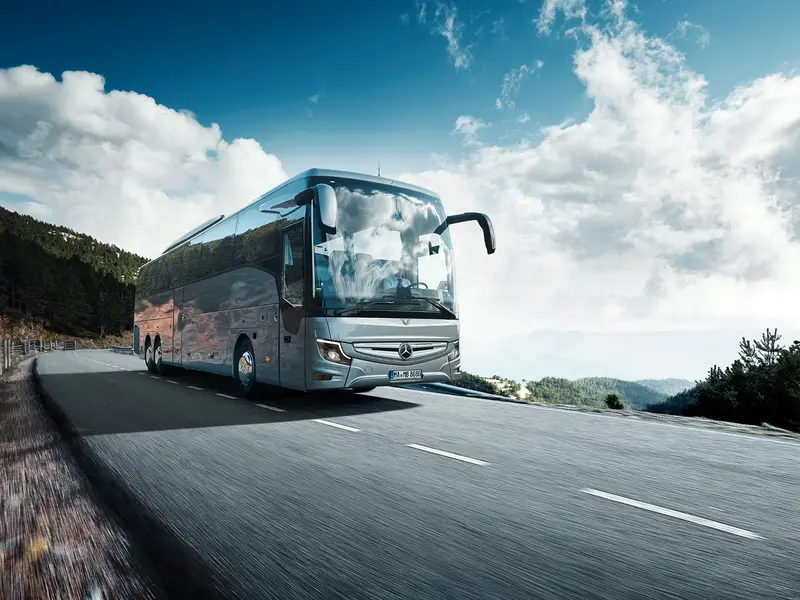
The Mercedes-Benz Integro and the Mercedes-Benz Intouro are the intercity buses Mercedes-Benz builds for regional routes (run in Greece by the regional bus operators, KTEL), school transport and staff shuttles. The Integro was built from 1996 to 2018, while the Intouro has been built in Turkey since 1999 and is now in its third generation.
The two models do similar work but differ in length, era and equipment. Below you will find the history of each, tables of versions and engines, a direct comparison and what to check when you buy a used intercity bus.
What is the Mercedes-Benz Integro?
The Integro (factory code O 550) is an intercity bus launched in 1996 as the successor to the O 408. It was built in 12, 13 and 15 metre lengths, received a facelift in autumn 2005 and went out of production in 2018.
It was one of the first models from EvoBus, the Daimler bus company that brought Mercedes-Benz and Setra together. The 13-metre Integro M arrived in 2002, and the three-axle, 15-metre Integro L offered up to 69 seats. Until 2006 there was also the Integro H, a high-floor version.
| Integro version |
Length |
Axles |
Seats |
| Integro |
12 m |
2 |
49 to 55 |
| Integro M (from 2002) |
13 m |
2 |
53 to 59 |
| Integro L |
15 m |
3 |
57 to 69 |
| Integro H (until 2006) |
12 m |
2 |
55 |
Which engines does the Integro have?
The Integro started with the OM 447 hLA (Euro 2), switched to the OM 457 hLA with Euro 3 in 2001, reached Euro 4 with SCR after the facelift and Euro 5 from 2010. Euro 6 versions use the OM 936 in the two-axle models and the OM 470 in the three-axle L.
| Period |
Engine |
Emission class |
| 1996 to 2001 |
OM 447 hLA |
Euro 2 |
| 2001 to 2005 |
OM 457 hLA |
Euro 3 |
| 2005 to 2010 |
OM 457 hLA with SCR |
Euro 4 |
| 2010 onwards |
OM 457 hLA with SCR |
Euro 5 |
| Euro 6, two-axle |
OM 936, 7.7 l, 220 or 260 kW |
Euro VI |
| Euro 6, Integro L |
OM 470, 10.7 l, 265 or 290 kW |
Euro VI |
Euro 4 and Euro 5 buses need AdBlue, because Mercedes-Benz met the limits with SCR (BlueTec). We explain what this means in daily operation in Euro 5, EEV or Euro 6 for a used bus.
How do you tell a pre- and post-2005 facelift Integro apart?
The most reliable test is the engine and emission class in the documents. Integros built before the autumn 2005 facelift are Euro 2 or Euro 3 without AdBlue, while later ones are Euro 4, Euro 5 or Euro 6 with an SCR system.
The difference matters when you buy. A Euro 3 Integro has a simpler exhaust system, but it is shut out of contracts and cities that require a newer class. A Euro 5 Integro is the usual compromise between price and range of uses. A Euro 6 Integro comes from the last production years, up to 2018, and has the newer OM 936 or OM 470 engines. Always ask for a photo of the registration document and the engine plate before you compare prices across listings. Two Integros of the same year can belong to different emission classes.
What is the Mercedes-Benz Intouro?
The Intouro is an intercity bus built since 1999 at the Mercedes-Benz Türk plant in Hoşdere, near Istanbul. The first generation (O 560) was a 12-metre bus in high-floor versions, originally sold only in Eastern Europe and the Middle East.
The second generation arrived in 2006 as a multi-purpose bus for scheduled routes, excursions and transfers, with new lengths (K, M and L) and Euro IV and Euro V engines with BlueTec. The third generation followed in 2020, technically closer to the Tourismo, and since 2022 it has also been available with a mild hybrid system. By October 2025 Daimler had delivered more than 20,000 Intouros.
| Intouro version (3rd generation) |
Length |
Axles |
Max. seated passengers |
| Intouro K |
10.75 m |
2 |
46 |
| Intouro |
12.18 m |
2 |
55 |
| Intouro M |
13.09 m |
2 |
63 |
| Intouro L |
14.88 m |
3 |
71 |
The third generation uses the OM 936 engine, while the three-axle Intouro L has the 10.7-litre OM 470 with 290 kW. In the second generation, the Euro 6 versions also use the OM 936.
What is the difference between the Integro and the Intouro?
The main difference is era and position in the range. The Integro was the intercity model with the most versions until 2018, while the Intouro started as a cheaper alternative and is now the only one of the two still in production. On the used market you will find Integros up to 2018 and Intouros of every generation.
|
Integro |
Intouro |
| Production |
1996 to 2018 |
since 1999 |
| Plant |
Germany |
Hoşdere, Turkey |
| Lengths |
12, 13, 15 m |
10.75 to 14.88 m (3rd gen.) |
| Max. seats |
up to 69 (Integro L) |
up to 71 (Intouro L, 3rd gen.) |
| Euro 6 |
OM 936 / OM 470 |
OM 936 / OM 470 (L) |
| Best suited to |
Regional routes, school runs, staff |
Regional routes, school runs, staff, excursions |
For a buyer, a Euro 5 Integro is usually the most economical choice for an intercity route. A third-generation Intouro has newer safety systems such as Active Brake Assist 6, Sideguard Assist 2 and Lane Keeping Assist, but it costs more.
What jobs suit the Integro and the Intouro?
They suit regional routes, school transport, staff shuttles for factories and hotels, and municipal routes out to the villages. They have more seats than a city bus and better suspension for intercity speeds, but less luggage space than a coach.
- Length: a 12-metre bus handles most jobs. The M gives you more seats on two axles, and you only need the L or Integro L for very busy routes.
- Gearbox: on routes with many stops, an automatic is less tiring for the driver.
- Doors: two doors speed up boarding on school runs.
- Emission class: if the contract requires Euro 6, look for an Integro built after 2014 or an Intouro.
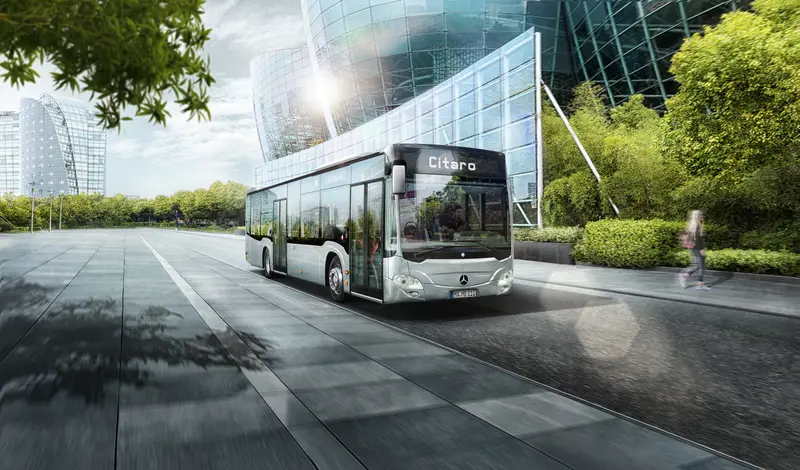
If you want a bus that also handles excursions with luggage, a Mercedes-Benz Tourismo coach is the better choice. If your routes are mostly within the city, have a look at the Citaro city bus.
What should you check on a used Integro or Intouro?
On a used Integro or Intouro, check the underbody for rust, the doors and steps, seats and belts, the gearbox, the brakes and the AdBlue system. Intercity buses often run school routes on rural roads, so the suspension and underbody need close attention.
- Underbody and rust: winter, road salt and dirt roads leave their mark on the frame.
- Doors and steps: heavy use on school runs wears out mechanisms and seals.
- Seats and belts: the seat count must match the registration document, and every belt must work.
- AdBlue and SCR: on Euro 4 and Euro 5 buses the SCR system needs clean AdBlue and working sensors.
- Suspension: the bus should stand level after a stop, with no air leaks.
You will find the full list, with what each finding means, in our pre-purchase inspection checklist.
Where can you find a used Integro or Intouro?
The buses currently available are on our used Mercedes-Benz Integro and Intouro page and among all the intercity and touring coaches in our catalogue. We own every vehicle, and they are at our premises in Litochoro, Pieria. We prepare the paperwork ourselves, so the bus is delivered ready for registration, and if you are taking it abroad we issue export plates (Zoll).
If you need a specific length or number of seats for a contract, tell us your requirements and we will search for it. Call +30 23520 61222 or send a message on WhatsApp (+30 6977 400157).

 The HellasBus team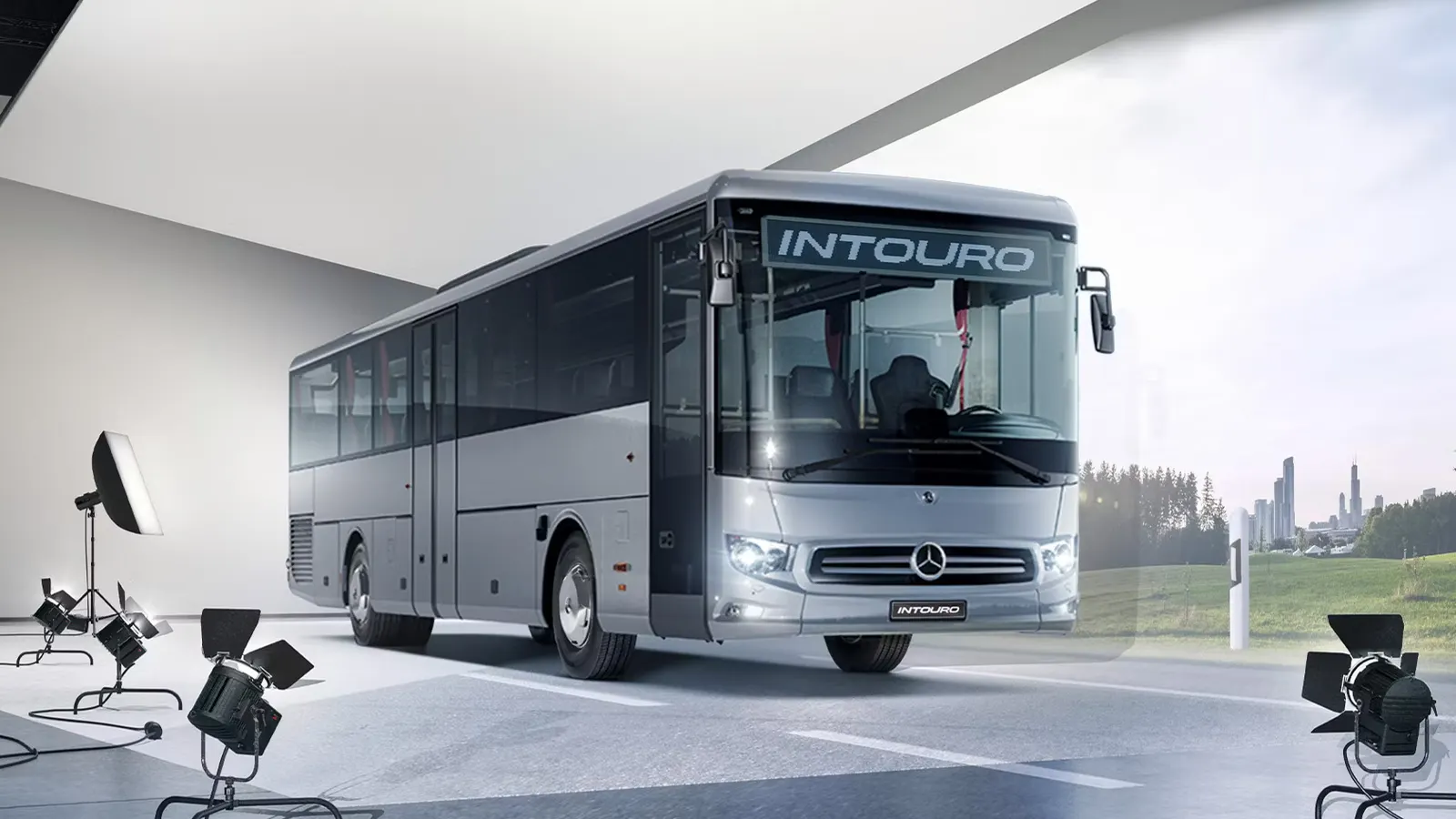

 Models