The Mercedes-Benz Tourismo is the high-deck touring coach from Mercedes-Benz, in production since 1994. It has gone through three generations (1994, 2006 and 2017), and the 30,000th was delivered in 2019, when Daimler described it as the best-selling coach in Europe.
If you are looking for a used coach for excursions or long-distance work, the Tourismo is one of the first names you will hear. Below you will find the generations, what the 15, 16 and 17 RHD names mean, lengths and seats, engines, and what to check before you buy.
What is the history of the Mercedes-Benz Tourismo?
The Tourismo was launched in 1994 as the O 350 Tourismo, and it was the first Mercedes-Benz bus to carry a name instead of a number. The first version was a two-axle high-deck coach (RHD), mostly 12 metres long, with disc brakes on all wheels.
Production takes place mainly in Turkey, at the Mercedes-Benz Türk bus plant. About ten years after the launch, with more than 12,000 sold, Mercedes-Benz brought out the anniversary series “Edition 10.000”.
| Year |
Milestone |
| 1994 |
Premiere as the O 350 Tourismo, 12 m, two axles |
| 2006 |
Second generation, lengths from 12.1 to 14 m, ESP |
| 2013 |
20,000 vehicles since 1994 |
| 2014 |
Lane Assist and an autonomous emergency braking system |
| 2017 |
Third generation, world premiere in Brussels |
| 2019 |
The 30,000th Tourismo is handed over in Warsaw |
| 2023 |
LED headlamps, MirrorCam, Active Brake Assist 6 |
How many Tourismo generations are there?
There are three generations: the first (O 350, 1994 to 2006), the second (2006 to 2017) and the third (from 2017). The second added lengths and three-axle versions, and the third was the first all-new Mercedes-Benz touring coach in almost 20 years.
The second generation arrived in autumn 2006, after more than 12,000 sales of the first. It came in three lengths from 12.1 to 14 metres, with two or three axles, and it added ESP and automated or fully automatic gearboxes.
The third generation was presented in Brussels in 2017 and went on sale that autumn, after more than 26,000 second-generation coaches. Daimler reported an investment of about 400 million euros, 200 kg less weight and up to 7% lower fuel consumption. It came with Active Brake Assist 4 and Sideguard Assist (blind-spot monitoring on the right-hand side).
What do the 15, 16 and 17 RHD names mean?
The names 15 RHD, 16 RHD and 17 RHD are the third-generation versions. RHD stands for high-deck coach (Reisehochdecker), and the number goes up with the length: 15 RHD for 12.3 m, 16 RHD for 13.1 m and 17 RHD for 13.9 m.
| Version (3rd generation) |
Length |
Axles |
Maximum seats |
| Tourismo 15 RHD |
12,295 mm |
2 |
53 |
| Tourismo 16 RHD/2 (M/2) |
13,115 mm |
2 |
57 |
| Tourismo 16 RHD/3 (M/3) |
13,115 mm |
3 |
57 |
| Tourismo 17 RHD (L) |
13,935 mm |
3 |
63 |
In the second generation the names were descriptive: RHD (12.14 m), RHD M/2 and RHD M (12.96 m, with two or three axles), RHD L (13.99 m) and the short K (10.32 m). There were also the lower RH versions. The seat numbers in the table are maximums. With a toilet, a kitchen or a wider seat pitch, a 16 RHD can have several seats fewer.
Which engines does the Tourismo have?
The second generation has the OM 457 LA in the Euro 5 versions and the OM 470 in the Euro VI versions, with 260 to 315 kW. The third generation has the OM 470 (10.7 litres) or the smaller OM 936 (7.7 litres, 260 kW and 1,400 Nm).
| Generation |
Engine |
Emission class |
| 2nd (2006 to 2017) |
OM 457 LA |
Euro 5 |
| 2nd (2006 to 2017) |
OM 470 |
Euro VI |
| 3rd (from 2017) |
OM 470, 10.7 l |
Euro VI |
| 3rd (from 2017) |
OM 936, 7.7 l, 260 kW |
Euro VI |
The OM 936 is lighter and is enough for 12-metre versions and for work without much mountain driving. For three-axle coaches, full loads and mountain routes, choose the OM 470. We explain what changes between Euro 5 and Euro 6 in daily operation, with AdBlue and the particulate filter, in Euro 5, EEV or Euro 6.
Which safety systems does each Tourismo generation have?
The second generation brought ESP from 2006 and, from 2014, Lane Assist and an emergency braking system. The third generation started in 2017 with Active Brake Assist 4 and Sideguard Assist, and in 2023 it moved to Active Brake Assist 6, Sideguard Assist 2 and Frontguard Assist.
| Period |
Systems |
| 2006 (2nd generation) |
ESP, automated and automatic gearboxes |
| 2014 (2nd generation) |
Lane Assist, advanced emergency braking system (AEBS) |
| 2017 (3rd generation) |
Active Brake Assist 4, Sideguard Assist |
| 2023 (3rd generation) |
Active Brake Assist 6, Sideguard Assist 2 also on the driver’s side, Frontguard Assist, LED headlamps, MirrorCam as an option |
For a used-coach buyer, these systems cut both ways. They help the driver on long days at the wheel and reduce the risk on motorways and in town. They also need radar sensors and cameras in good condition and correctly calibrated, so ask for a fault-code readout during the inspection and test the warnings on the road.
Which Tourismo should you choose for your work?
For school trips, staff transport and airport transfers, a two-axle 15 RHD or 12-metre RHD is more manoeuvrable and cheaper on tyres and tolls. For multi-day tours with plenty of luggage and more seats, a three-axle 16 RHD/3 or 17 RHD gives you space and stability.
- Seats and layout: how many seats you really need, and whether you want a toilet or a kitchen.
- Axles: three axles mean more payload but also more tyres.
- Emission class: Euro 6 for cities abroad with low-emission zones.
- Gearbox: automated or automatic, depending on your drivers.
For smaller groups and narrow mountain roads, the second generation also offered the short Tourismo K at 10.32 metres. If your routes go through villages and ports where a 13-metre coach struggles, ask us for one and we will look for it.
If you run more scheduled routes than tourist work, also look at the intercity Integro or Intouro. For a comparison with the MAN equivalent, read about the Lion’s Coach.
What should you check on a used Tourismo?
On a used Tourismo, check the engine and gearbox, the retarder, the air conditioning, the luggage hold, the seats and toilet, and on three-axle coaches the steered rear axle. A coach covers a lot of its mileage on motorways, so its kilometres count differently from those of a city bus.
- Retarder: on a touring coach it works on every descent. Test it on a downhill stretch and check the temperature.
- Air conditioning: run it at full power for 15 minutes, check every vent and listen for noise from the roof unit.
- Luggage hold: locks, seals and damp, because that is where your customers’ luggage travels.
- Seats, belts and toilet: everything should work, and the number of seats should match the registration certificate.
- Third axle: on three-axle coaches, tyre wear and how the steered axle works.
- Driver assistance systems: on the third generation, there should be no faults in emergency braking, lane monitoring or blind-spot monitoring.
You will find the full list, with what each point tells you, in our pre-purchase inspection checklist.
Where can you find a used Tourismo?
The Tourismo coaches we have available are on the used Mercedes-Benz Tourismo page, and all our coaches are under intercity and touring coaches. We own every vehicle, and they are at our yard in Litochoro, Pieria, ready for inspection and a test drive.
If you need a specific version, for example a 17 RHD with a toilet, tell us the number of seats, the year and your budget, and we will look for it. Call +30 23520 61222 or send a WhatsApp message to +30 6977 400157.

 The HellasBus team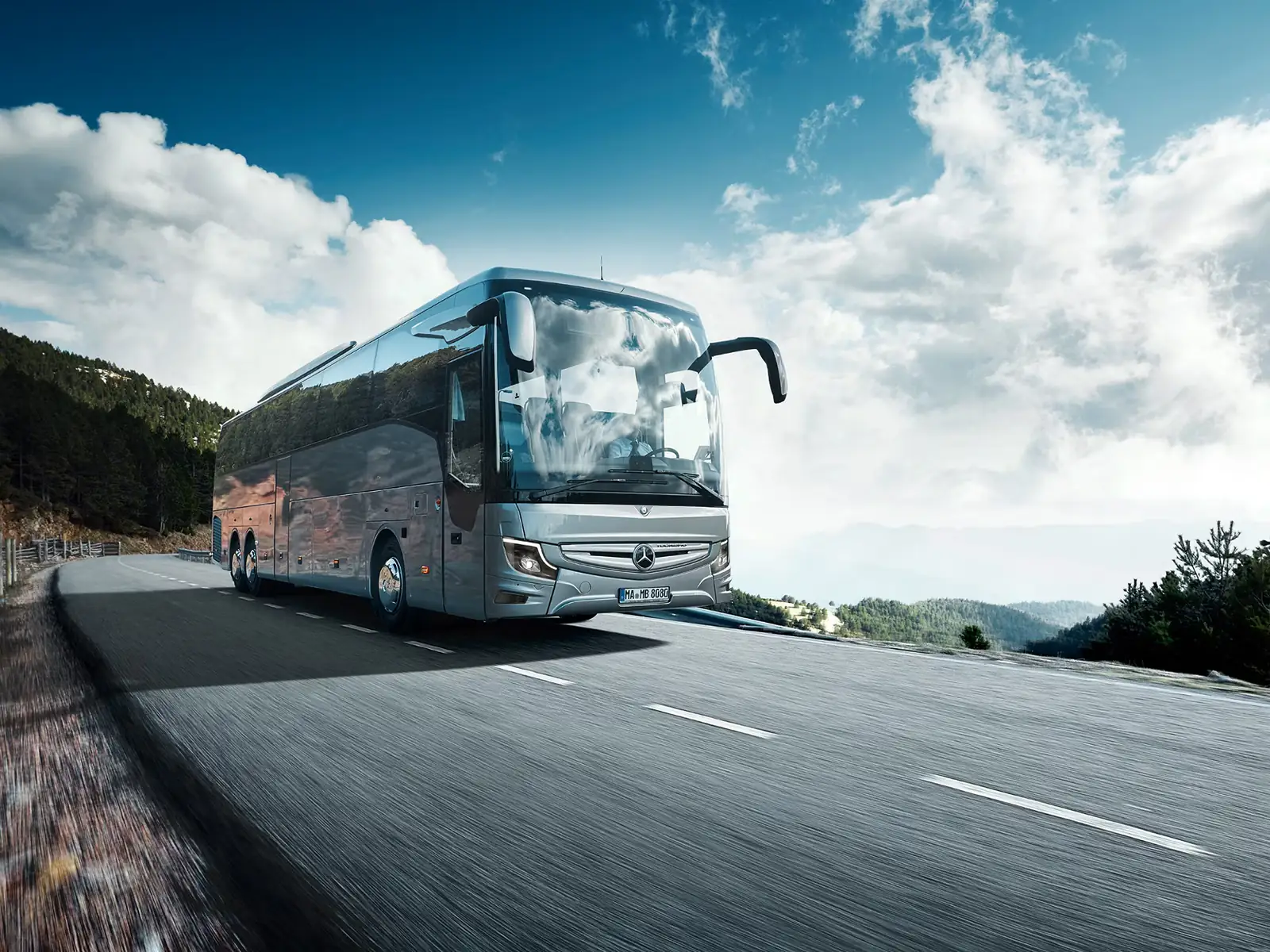

 Models