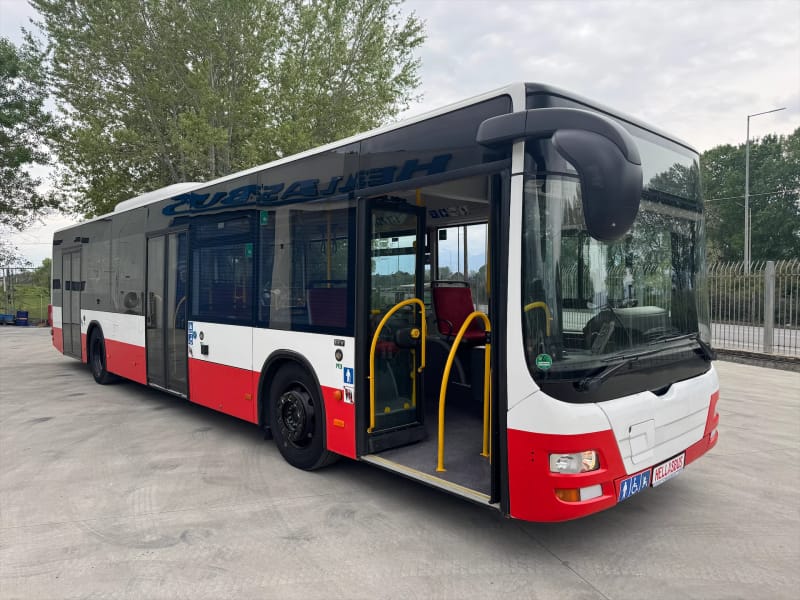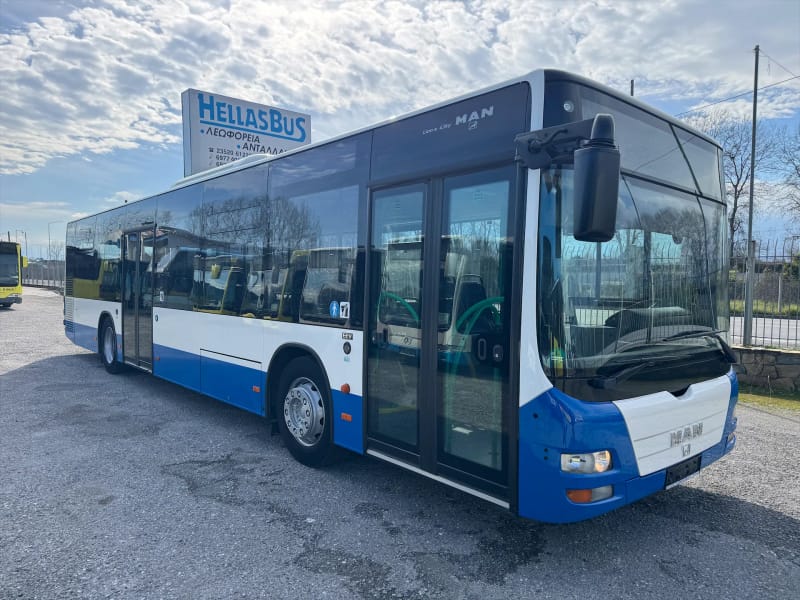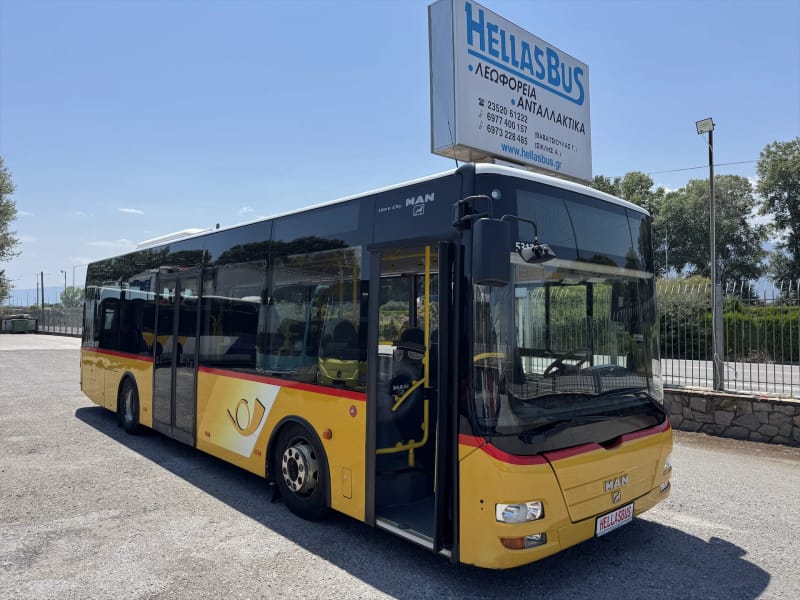
City bus
MAN A66 (9.8m)
- Year of manufacture
- 2011
- Mileage
- 350,646 km
- Gearbox
- AUTOMATIC
- Emission class
- EURO 5 EEV
€34,900 + VAT
More...Mon-Fri 08:00-17:00 · Sat 09:00-15:00 23520 61222 6977 400157 6973 228485

The history of MAN buses from 1915 to the Lion's City and Lion's Coach, and what type codes A21, A37, A66 and NL 263 mean when you read used bus listings.
 The HellasBus team 7 min read
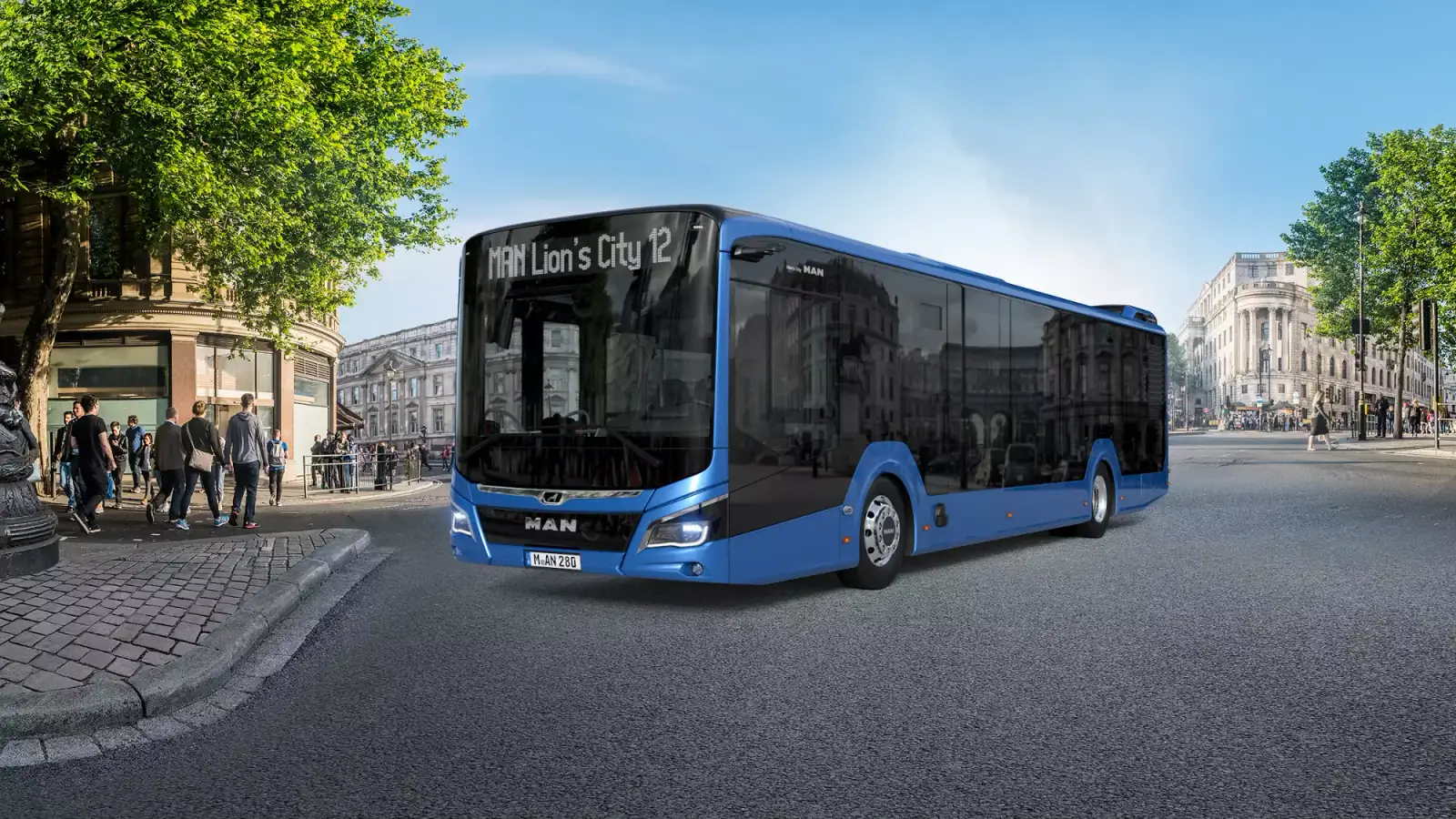
MAN has built commercial vehicles since 1915, when truck production started in Lindau, Germany, together with the Swiss company Saurer, and it has made buses since its early years. Today its best-known buses are the Lion’s City for urban service and the Lion’s Coach for touring.
In used bus listings, our own stock included, MAN city buses often appear under codes such as A21, A37 or A66 and names such as NL 263. Below you will find the history, what each code means and what to check on a used MAN bus.
MAN entered commercial vehicles in 1915 through the joint company M.A.N.-Saurer in Lindau. In 1924 it presented the world’s first direct-injection diesel engine for a vehicle, together with buses on a low-frame chassis.
A few years later it built its first three-axle buses and trolleybuses. In 1971 MAN took over Büssing, and the Salzgitter plant became its bus production centre. It bought Neoplan in 2001, and since 2011 the company has been called MAN Truck & Bus.
| Year | Milestone |
|---|---|
| 1915 | Truck production starts, M.A.N.-Saurer in Lindau |
| 1924 | First direct-injection diesel engine for a vehicle, low-frame buses |
| 1971 | Büssing takeover, bus production in Salzgitter |
| 1992 | Lion’s Star coach (Coach of the Year 1994) |
| 1996 | First Lion’s Coach, built in Ankara |
| 1997 | A21 low-floor city bus (NL xx3) |
| 2001 | Neoplan takeover |
| 2004 | The name “Lion’s City” for all city buses |
| 2018 | New Lion’s City generation |
| 2020 | Series production of the electric Lion’s City E in Starachowice, Poland |
The Lion’s City is MAN’s family of city buses. The name arrived in September 2004 as the sales name for every MAN city bus, which until then had been sold under designations such as NL 263 or NG 313. In autumn 2004 all models were presented with updated styling and engineering.
The family covers 12-metre solo buses, 18-metre articulated buses, long versions of 13.7 and 14.7 metres, a 10.5-metre midibus, low-entry (LE) versions and a hybrid. Most low-floor city buses are built in Starachowice, Poland, while the Lion’s City LE comes from Ankara.
A new Lion’s City generation on a new platform was announced in July 2017. MAN launched it in 2018, and series production started in 2019. The electric Lion’s City E has been built in series since 2020.
A21, A37 and A66 are MAN’s internal type codes. They are part of the chassis number (VIN) and describe the basic design of the vehicle, which is why listings often use them in place of a model name. One code can cover vehicles from many years and several emission classes.
| Code | What it is | From | Length |
|---|---|---|---|
| A20 | Low-floor intercity bus (Lion’s City Ü / NÜ) | 1995 | approx. 12 m |
| A21 | Low-floor solo city bus (NL xx3), successor to the A10 | 1997 | 11,980 mm |
| A23 | Low-floor articulated bus (NG xx3), successor to the A11 | 1998 | 17,980 mm |
| A26 | 15-metre city bus (Lion’s City L) | 2000 | approx. 14.7 m |
| A37 | Solo city bus with upright engine and three doors, later also the Lion’s City Hybrid | 2002 | 11,980 mm |
| A47 | MAN midibus, 2.5 m wide | late 2005 | 10,500 mm |
| A66 | Low-entry midibus with Göppel body on a 14.xxx HOCL-NL chassis | Lion’s City styling from 2007 | approx. 8.6 to 10.5 m |
| A78 | Low entry, later Lion’s City LE / LE Ü | renamed in 2008 | 11,857 mm |
The A37 started in 2002 as a three-door bus for the Italian and Spanish markets. Its upright engine sits in one rear corner, so the floor stays low along the whole aisle. MAN later used the same code for the Lion’s City Hybrid with supercapacitors, available from 2010. The A66 is a smaller low-entry bus suited to narrow streets, with the 6.9-litre D0836 engine.
Before you buy, ask for the registration document and check the code in the chassis number. A 1999 “MAN A21” and a 2008 one differ a great deal in engine, emission class and equipment.
The first letter shows the floor type and the second the body layout: N for low floor, E for low entry, L for solo, G for articulated, D for double-decker and Ü for intercity. Drop the last digit of the number and you get roughly the output in horsepower, so an NL 263 has about 260 PS.
The final digit 3 marks the series. NL 263, NL 283 and NL 313 all belong to the xx3 series, and their predecessors were the NL xx2 (A10). A “MAN NL 263 A21” is therefore a low-floor solo city bus from the xx3 series with about 260 hp.
Buses we own, parked at our premises in Litochoro, Pieria, ready to be inspected.
City bus
€34,900 + VAT
More...City bus
Contact us for price
More...City bus
€27,900 + VAT
More...MAN Lion’s City buses mainly use inline six-cylinder engines. You will find the horizontally mounted 10.5-litre D2066, the larger 12-litre D2866 in older buses and the 6.9-litre D0836 in the midibuses. Natural gas versions were also built.
| Engine | Displacement | Installation | Where you find it |
|---|---|---|---|
| D2066 LUH | 10.5 l | Horizontal | Lion’s City solo and articulated buses |
| D2866 LUH | 12 l | Horizontal | Older city buses |
| D0836 | 6.9 l | Upright or horizontal | Midibuses such as the A66, A48 double-deckers |
| E2876 LUH | Natural gas | Horizontal | Lion’s City CNG |
What changes in daily use between Euro 5, EEV and Euro 6, with AdBlue and a particulate filter, is covered in Euro 5, EEV or Euro 6.
The Lion’s Coach is MAN’s touring coach. It was presented in 1996 and is built in Ankara by the subsidiary MANAŞ. The second generation (2002 to 2017, with internal codes such as R07 and R09) had D2066 (10.5 l) and D2676 (12.4 l) engines, and the third was presented at Busworld in Kortrijk on 24 October 2017.
| Lion’s Coach (3rd generation) | Length | Axles |
|---|---|---|
| Lion’s Coach | 12,101 mm | 2 |
| Lion’s Coach C | 13,091 mm / 13,361 mm | 2 / 3 |
| Lion’s Coach L | 13,901 mm | 3 |
The third generation has the 12.4-litre D2676 LOH, Euro VI, with 316 to 375 kW depending on the version, and was voted Coach of the Year 2020. Used examples are listed on our page for used MAN Lion’s Coach buses. For a comparison with the equivalent Mercedes-Benz coach, see the Tourismo.
On a used MAN, check the type code and engine in the registration first. Then move on to the automatic gearbox, the doors, the air suspension and kneeling, rust and, on Euro 5, EEV and Euro 6 buses, the exhaust aftertreatment system.
The points that apply to every bus, and what each finding means, are in our pre-purchase inspection checklist. If you are comparing with a Mercedes-Benz city bus, read about the Citaro.
The MAN city buses we have available are on the used MAN Lion’s City page, and all city buses are under city buses. The vehicles are our own and stand at our premises in Litochoro, Pieria, where you can check the code and the engine and take a test drive.
If you are looking for a specific code, for example an A21 Euro 5 or a three-axle Lion’s Coach, tell us and we will search for it. Call +30 23520 61222 or send a message on WhatsApp (+30 6977 400157).
A21 is MAN's internal type code for the low-floor solo city bus of about 12 metres (11,980 mm), successor to the A10, built from 1997. The code is part of the chassis number, and listings often use it as the model name.
Both are solo city buses of about 12 metres. The A37 arrived in 2002 with an upright rear engine and three doors, originally for the Italian and Spanish markets. MAN later also used the A37 code for the Lion's City Hybrid.
N stands for low floor and L for a solo bus, while a G would mean articulated. Drop the last digit of the number and you get roughly the output in horsepower: about 260 PS for the NL 263 and about 280 PS for the NL 283. The final 3 marks the series, and the predecessors were the NL xx2.
The Lion's Coach was presented in 1996 and is built in Ankara, Turkey. The second generation came in 2002, and the third was presented at the Busworld show in Kortrijk on 24 October 2017.
 Models
 7 min read
Mercedes-Benz Citaro since 1997: O530 and C2 generations, K, G, LE and Ü versions, OM 906, OM 457, OM 936 and OM 470 engines, and what to check on a used Citaro.
Read the article Models
 7 min read
Mercedes-Benz Integro (1996-2018) and Intouro (since 1999): generations, lengths, seats, engines and which intercity bus suits regional and school routes.
Read the article Models
 7 min read
Mercedes-Benz Sprinter as a minibus: generations since 1995, what 516 and 519 mean, engines, seats, D1 or D licence and what to check before you buy a used one.
Read the articleCall or message us: we tell you what we have in stock and search for what we do not.