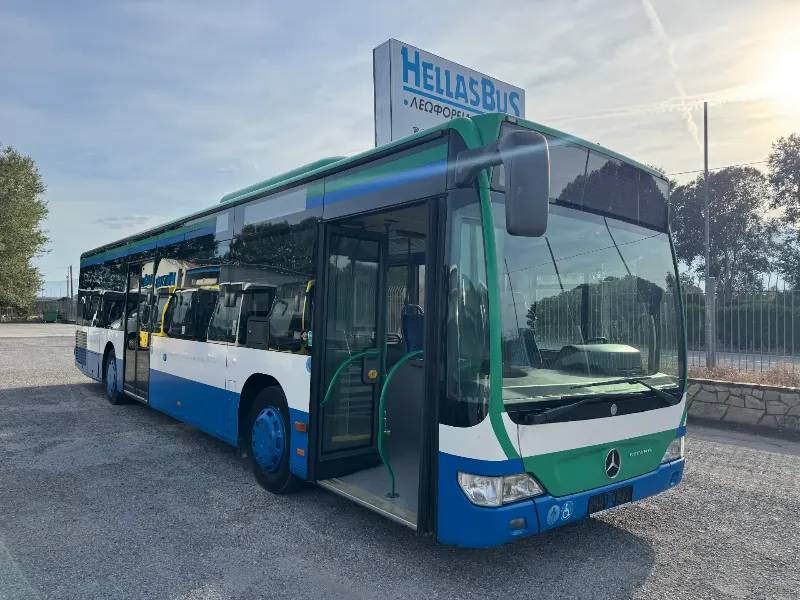
City bus
MERCEDES-BENZ CITARO
- Year of manufacture
- 2010
- Mileage
- 585,095 km
- Gearbox
- AUTOMATIC
- Emission class
- EURO 5
€16,900 + VAT
More...Mon-Fri 08:00-17:00 · Sat 09:00-15:00 23520 61222 6977 400157 6973 228485

City bus, intercity bus, coach or minibus: differences in floor, doors, seats, luggage and the Class I, II, III categories, and which type fits your business.
 The HellasBus team 7 min read
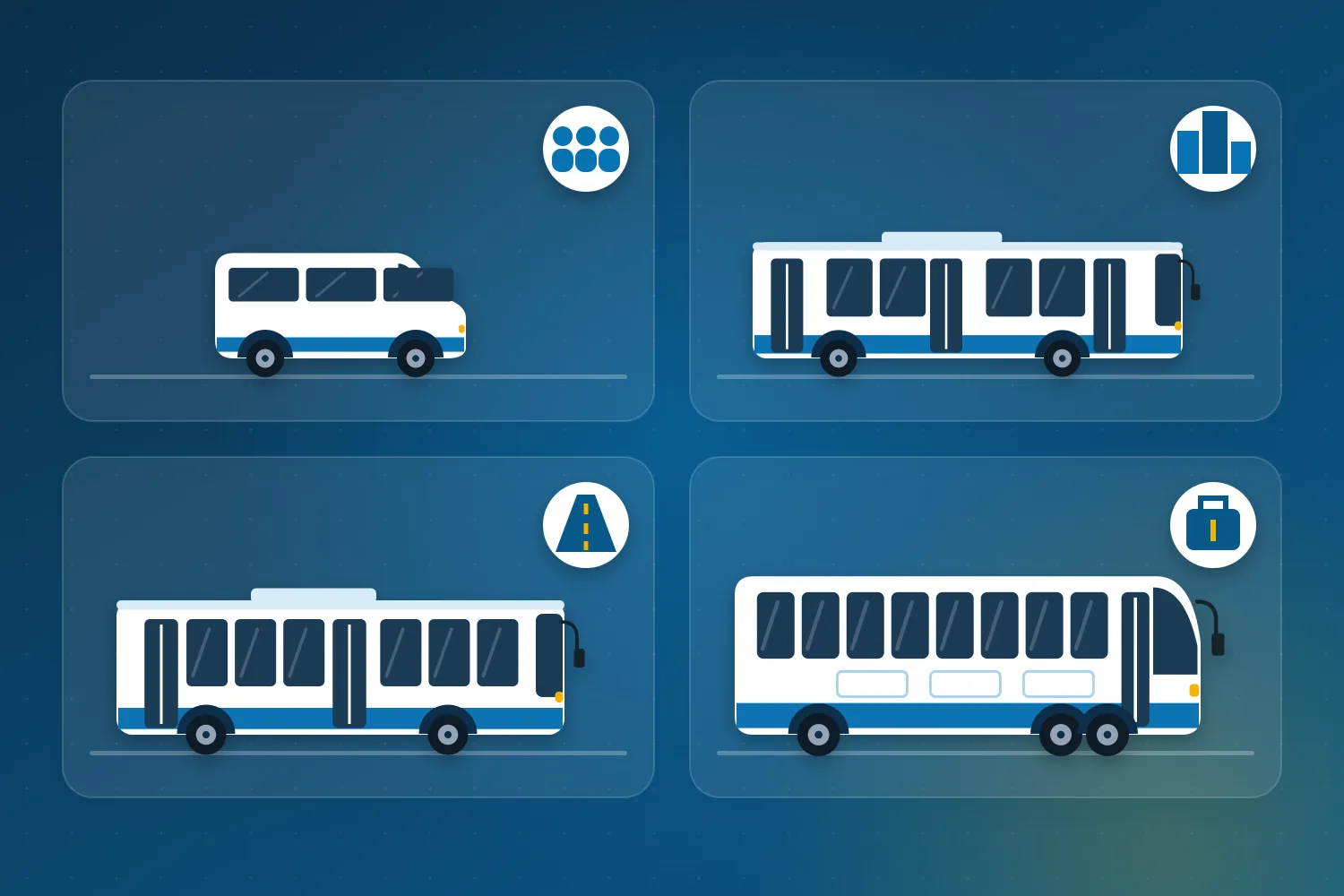
The right bus follows from the route and the passengers: a city bus for urban lines with standing passengers and frequent stops, an intercity bus for scheduled routes outside town, a coach for excursions and long distances with luggage, and a minibus for groups of up to about 20 people. Each type has a different floor, doors, seats, suspension and gearbox.
At HellasBus we sell all four types and help you choose before you look at specific vehicles. Below are the differences, the official categories and practical examples for each kind of work.
There are four main types: city bus, intercity bus, coach and minibus. They differ in how many passengers they carry, whether those passengers sit or stand, how far they travel and how much luggage they bring.
| City bus | Intercity bus | Coach | Minibus | |
|---|---|---|---|---|
| Floor | Low, no steps | Normal or low entry | High | Depends on the body |
| Doors | 2 to 4, wide | Usually 2 | 1 or 2 | 1 or 2 |
| Passengers | Many standing | Mainly seated | Seated only | Mainly seated |
| Luggage | None | A little | Large luggage holds | A little, or a trailer |
| Gearbox | Automatic | Automatic or automated | Automated or automatic | Manual or automatic |
| Examples | Citaro, Lion’s City | Integro, Intouro | Tourismo, Lion’s Coach | Sprinter 516, 519 |
Classes I, II and III come from UN Regulation No. 107 for buses carrying more than 22 passengers, and they appear in the vehicle’s approval documents. Class I means areas for standing passengers and frequent passenger movement, Class II mainly seated passengers with a few standing, and Class III seated passengers only.
| Class | What it defines | Typical vehicle |
|---|---|---|
| Class I | Standing areas, frequent passenger movement | City bus |
| Class II | Mainly seated, standing in the aisle or a small area | Intercity bus |
| Class III | Seated passengers only | Coach |
| Class A | Up to 22 passengers, with standing | Small city bus |
| Class B | Up to 22 passengers, no standing | Minibus |
A vehicle can be approved for more than one class. Separately, the EU classifies buses as M2 (maximum mass up to 5 tonnes) or M3 (over 5 tonnes). A Sprinter of up to 5 tonnes is M2, a Citaro is M3. In practice you can also see the class on the registration certificate: a Class III coach lists zero standing places, while a Class I city bus lists dozens of standing places next to the seats.
A city bus is right when you run an urban line with many stops, short journeys and passengers getting on and off all the time. The low floor, wide doors and wheelchair ramp make boarding quick for everyone.
City buses have fewer seats and plenty of standing room, an automatic gearbox and suspension that kneels at the stop. They are not built for high speeds or luggage. If your line serves many older passengers, parents with pushchairs or wheelchair users, the low floor and ramp make every stop faster and safer. The most common used models are the Mercedes-Benz Citaro and the MAN Lion’s City, in lengths from about 10.5 to 18 metres.
An intercity bus suits regional scheduled lines (in Greece, the KTEL operators), school transport, staff transport and municipal routes out to villages. It has more seats than a city bus, suspension for speeds outside town and a little luggage space.
The layout is denser than in a coach, so more passengers fit in the same length. In the third generation of the Mercedes-Benz Intouro, for example, the maximum number of seats is 55 in the 12-metre version and 71 in the 14.9-metre three-axle model. You will find the versions and differences in our article on the Integro and Intouro.
Buses we own, parked at our premises in Litochoro, Pieria, ready to be inspected.
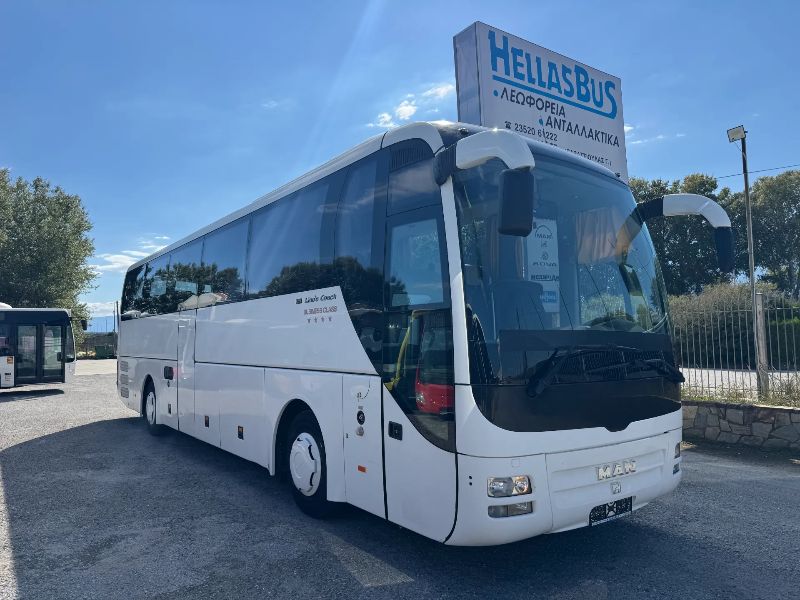
City bus
€16,900 + VAT
More...Intercity / tourist coach
€51,900 + VAT
More...Intercity / tourist coach
€29,900 + VAT
More...A coach suits excursions, multi-day tours, airport transfers with lots of luggage and motorway journeys. The high floor leaves room for large luggage holds underneath and gives passengers a better view.
Coaches have comfortable reclining seats, air conditioning with vents at each seat and often a toilet, fridge and screens. The Mercedes-Benz Tourismo comes in lengths from 12.3 to 13.9 metres in its third generation, with two or three axles. For more than 53 seats you need a 13- or 14-metre coach.
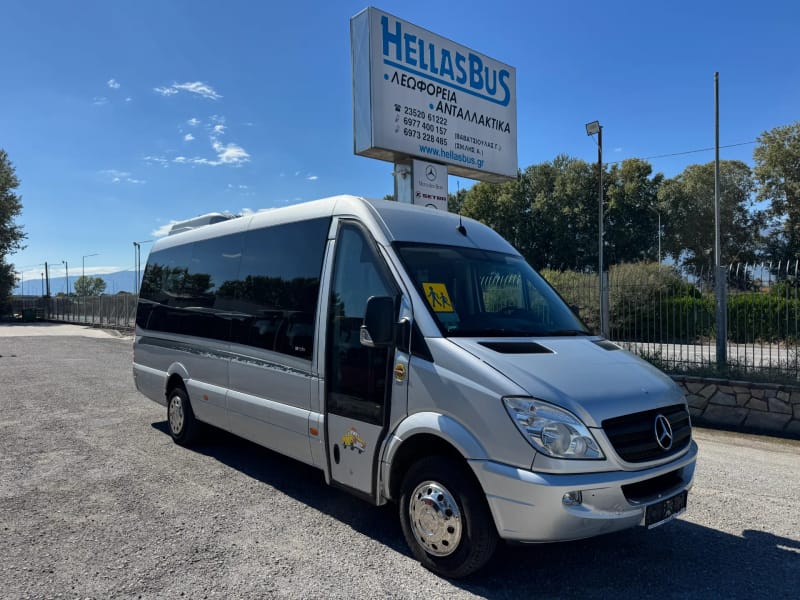
A minibus is right when you usually carry fewer than 20 passengers: hotel shuttles, VIP groups, school runs with a few children, village routes on narrow roads. It uses less fuel, parks easily and, with up to 16 passenger seats and a length of up to 8 metres, can be driven on a category D1 licence.
Most minibuses are based on the Mercedes-Benz Sprinter, in the 516 and 519 versions. They have hydraulic brakes and share their mechanicals with light commercial vans, so workshops that do not service large buses can maintain them. For more than 16 passenger seats the driver needs a category D licence, under Directive 2006/126/EC.
Yes, some models were designed for mixed use. The second-generation Mercedes-Benz Intouro, from 2006, was presented as a multi-purpose bus for scheduled services, excursions and transfers, and the intercity Ü versions of the Citaro leave town with more seats.
Mixed use has limits, though. An intercity bus handles a day trip without trouble, but on a multi-day tour with suitcases passengers will feel the difference from a coach. A coach can do school runs, but narrow doors and steps slow down boarding at every stop. If your work is split, choose the type for the job you do on most days.
Running costs depend mainly on size, number of axles and how the vehicle is used. A three-axle coach has more tyres and brakes, a city bus wears doors, brakes and gearbox in constant stop-and-go, and a minibus costs less across the board but carries fewer passengers.
Factor in tolls, which are charged by vehicle category, and insurance, which depends on seats and use. Before you decide, ask your accountant or insurer for an estimate for the specific type. We explain what maintenance each bus needs in our 10 maintenance tips.
Count the passengers on a normal day. A bus that fills up three times a year and runs half-empty the rest of the time costs you fuel, tyres and tolls every single day.
If one type cannot cover all your work, two smaller vehicles give you more flexibility than one large one. The next steps of a purchase are in our guide to buying a used bus, and what to check on the vehicle is in the inspection checklist.
In the HellasBus catalogue you will find city buses, intercity buses and coaches and Sprinter minibuses. We own every vehicle, they are all at our premises in Litochoro, Pieria, and they are handed over ready for registration plates, or with export plates if they leave Greece.
If you are not sure which type suits you, tell us about your work, your passengers and your budget and we will make a suggestion. Call +30 23520 61222 or send a WhatsApp message to +30 6977 400157.
An intercity bus is built for scheduled routes with stops: it usually has two doors, more seats in a tighter layout and little luggage space. A coach is built for long distances: high floor, large luggage holds, comfortable seats and often a toilet and a fridge.
They are the classes of UN Regulation No. 107 for buses carrying more than 22 passengers. Class I has areas for standing passengers and frequent movement (city buses), Class II carries mainly seated passengers with a few standing in the aisle (intercity buses), and Class III carries seated passengers only (coaches). For up to 22 passengers there are Classes A and B.
Technically it can carry passengers outside town, but it is a poor fit: few seats, no luggage space, and suspension and gear ratios set up for low speeds. For excursions choose a coach or, for small groups, a minibus.
Usually an intercity bus or a minibus, depending on the number of children and the driver's licence. Always check what the contract requires for year, seats, seat belts and emission class before you buy.
 Buying a bus
 7 min read
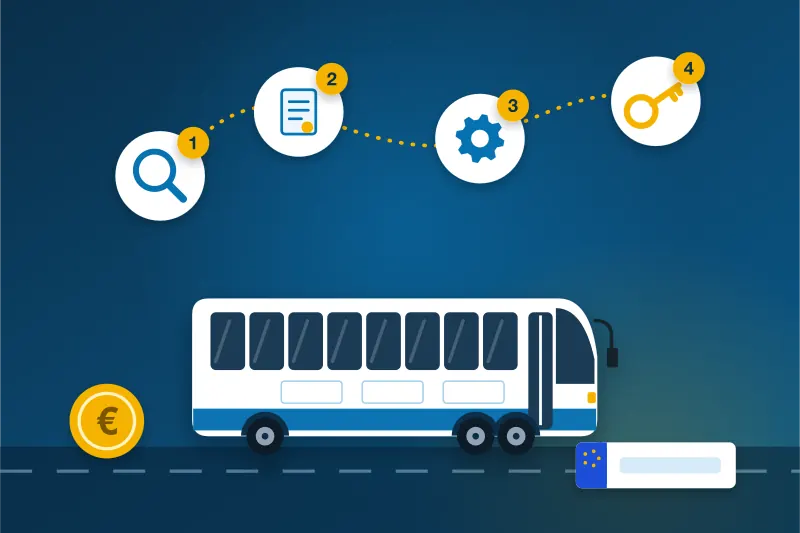
How to buy a used bus step by step: type, licence, Euro class, inspection, paperwork, KTEO and plates. The practical guide from HellasBus, selling since 2009.
Read the article Buying a bus
 7 min read
What to check on a used bus before you buy: papers, mileage, engine, gearbox, brakes, air system and rust. A checklist explaining what each point tells you.
Read the article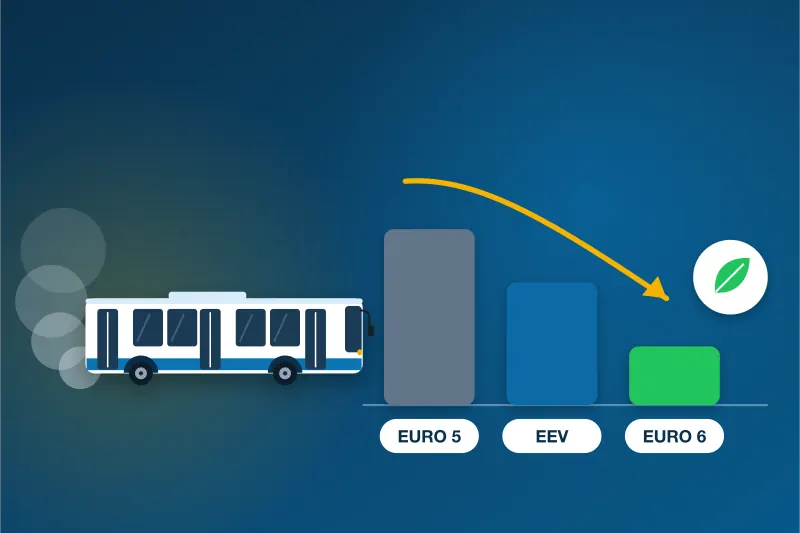 Buying a bus
 6 min read
Euro 5, EEV and Euro 6 buses compared: NOx and particulate limits, key dates, AdBlue, particulate filters and what each class means when you buy a used bus.
Read the articleCall or message us: we tell you what we have in stock and search for what we do not.